
Search Results
University of Nevada, Las Vegas School of Nursing Records
Identifier
Abstract
The University of Nevada, Las Vegas School of Nursing Records (1950-2025) contain records documenting the history of the UNLV School of Nursing. The materials include records from the nursing school's Alumni Association, including financial reports, bylaws, correspondence, and membership information; recruitment materials from the School of Nursing, including brochures, photographs, and program requirements; history of the School of Nursing, including photographs, newspaper clippings, a short summary of the program, and a short documentary film comprised of digital video files; and accreditation information, including newspaper articles, accreditation reports, and evaluations of the program from the Nevada State Board. The materials also include nursing student uniforms, caps, and nursing capes from the 1950s and 1960s.
Archival Collection
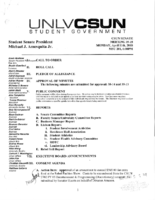
Meeting minutes for Consolidated Student Senate, University of Nevada, Las Vegas, April 11, 2005
Date
Archival Collection
Description
Text
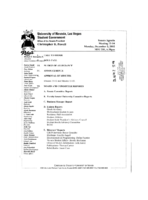
Meeting minutes for Consolidated Student Senate, University of Nevada, Las Vegas, December 02, 2002
Date
Archival Collection
Description
Text
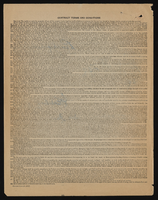
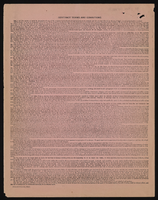
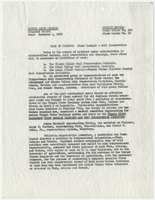
County agent project progress report, Flood control - soil conservation and soil conservation-domestic allotment, November 1, 1939
Date
Archival Collection
Description
Discussion of the formation of the Virgin River Watershed Flood Control District and Soil Conservation Committee and the efforts of all the individual soil conservation districts. Project Number: State Office No. 172. Clark County No. 12 and Project Number: State Office No. 284. Clark County No. 24
Text
Duy Ngyuen (Asian Community Development Council) oral history interview conducted by Magdalena Martinez: transcript
Date
Archival Collection
Description
From the Lincy Institute "Perspectives from the COVID-19 Pandemic" Oral History Project (MS-01178) -- Community organization interviews file.
Text
University of Nevada, Las Vegas (UNLV) Fall 2018 commencement program
Date
Archival Collection
Description
Commencement program from University of Nevada, Las Vegas Commencement Programs and Graduation Lists (UA-00115).
Text

University of Nevada, Las Vegas (UNLV) 47th commencement program
Date
Archival Collection
Description
Commencement program from University of Nevada, Las Vegas Commencement Programs and Graduation Lists (UA-00115).
Text

Transcript of interview with Sandra Peña by Lada Mead and Stefani Evans, March 27, 2017
Date
Archival Collection
Description
Sandra Peña’s story begins in East Los Angeles, where she spent her first fifteen years with her parents (both from Michoacán, Mexico), and her younger sister. The father's managerial position at Master Products allowed the family to live rent-free in a company-owned house behind the main factory, because he collected the rents for the company's two other dwellings. In this interview, Peña recalls the family move to Porterville, in California's Central Valley, her return to Los Angeles at nineteen, and her work with Parson’s Dillingham, a contractor for the Metrolink rail system. She draws the link between the Los Angeles and Las Vegas construction communities by describing her husband's move to Las Vegas to find work; a chance Las Vegas encounter with a friend from Chino, California; her ability to gain employment in Las Vegas at Parson’s, a company that had joint ventured with Parson’s Dillingham, and her move from there to Richardson Construction, a local minority-owned company. As Peña says, "It's kind of all intermingled. Even if you go here and you go there, it's like everybody knows everybody." Throughout, Peña weaves her family story into the narrative as she describes her youth, the birth of her son, the illness and death of her father, and her family's participation in her current employment with Richardson. As she remembers the people, places, and events of her life, Peña speaks to the ways one woman of color built on her interstate construction connections and rose in a male-dominated industry.
Text