Search Results

Transcript of interview with Mark Fine by Barbara Tabach, November 18 and December 2, 2014
Date
Archival Collection
Description
Interview with Mark Fine in two sessions, November 18 and December 2, 2014. In the first session, Fine begins by talking about his sons and their business interests, then discusses his own childhood growing up in Cleveland. Fine moved to Arizona as a teenager and attended the University of Arizona for college. After college, he moved to New York city, and describes his employment at Chemical Bank, and then at the investment firm Loeb, Rhoades. He was married and started a family in New York City, then moved to Las Vegas to assist in his in-laws' (the Greenspuns) business ventures, which included real estate development and Sun Outdoor Advertising. Fine talks about Las Vegas in the 1970s and building Green Valley and Summerlin, the "social engineering" aspects of developing a community and the importance of building incrementally. In Part II of the interview, Fine discusses his family history and raising his children in Las Vegas. He talks about the growth of the Jewish community and ph
Mark Fine was born in 1946 in Cleveland, Ohio, and was raised with a strong Jewish identity. When Mark was in fourth grade, his parents moved the family to Shaker Heights, and again moved to Arizona during his senior of high school. Upon graduation, Mark enrolled at the University of Arizona and became a member of the ZBT fraternity; determined to graduate in four years, he finished in 1964 with a degree in business administration with an emphasis in real estate. Though never having been, Mark took his degree to New York City and established a career on Wall Street, first working for Chemical Bank. In 1969, Mark married Susan Greenspun, and soon after, the couple had their first child. By this time, Mark had taken a new position with Loeb, Rhoades and Company, and worked there for nearly five years in their corporate finance department. In 1973, Mark moved to Las Vegas to assist his father-in-law, Hank Greenpun, with his nonnewspaper business operations, largely under the auspices of American Nevada Corporation. Mark soon capitalized on this passion for real estate and community development, leading several integrated real estate projects to create the Green Valley area, the city's first large-scale master-planned community. Mark went on to launch a similar project in Summerlin, and at one point, he was leading the development of the country's two fastest selling planned communities (Green Valley and Summerlin). Ultimately, Mark became one of state's prominent real estate developers, and continues to lead significant projects positively impacting the city's growth and appeal. His fundamental goal has always been to create a sense of place, to develop thriving communities with generational stamina. His success in this endeavor is recognized, in part, with the naming of Mark L. Fine Elementary School. Over the years, Mark has also been an important member of the Jewish community, among the "second generation of pioneers," coming after those heavily involved with the hotels during the 1950s and 1960s. He served on the Temple Beth Sholom board of directors, and initiated events to bring older and younger generations of the Jewish community together in meaningful ways. Mark has five children?Alyson Marmur, Katie Erhman, Jeffrey Fine and Jonathan Fine and Nicole Ruvo Falcone?and is married to Gloria Fine.
Text

Transcript of interview with Steven Eisen by Barbara Tabach, September 14, 2016
Date
Archival Collection
Description
Steven Eisen (1966 - ) is the oldest son of Barry and Beverly Eisen, who were part of the migration of Jews from St. Louis to Las Vegas in the 1960s. He is married to Stacy Fisher and the older brother to Andrew and Robert Eisen. They are members of an early group of born-and-raised Las Vegans. Growing up Jewish, he became a bar mitzvah, belonged to B?nai B?rith Youth Organization. In this oral history interview, Steve recalls enjoyable stories of growing up in Las Vegas and humorous anecdotes of mistaken identity since the three brothers bear such strong physical resemblances. Today he finds himself enjoying his career as CEO of the Children?s Heart Center since 2001 and talks about the success and reputation of the pediatric medical group. It was his first job as a fourteen year old helping Theodore Manos and Michael Cherry during the MGM fire litigations where he learned about the legal world and being organized as a path to success in whatever he might pursue. Steve graduated from University of Missouri, attended law school at Washington University in St. Louis, and received his business degree from UNLV. Throughout the interview, he recalls the steady and strong involvement of his parents in their sons? educations. He also describes their active connection with the Jewish community and organizations. Steve?s wife Stacy is a professor in physical therapy at Touro University.
Text

Transcript of interview with Lovee duBoef Arum by Barbara Tabach, November 1, 2016
Date
Archival Collection
Description
Lovee Arum is the Chief Financial Officer of the Morris A. Hazan Family Foundation and Director of Hospitality for her husband Bob Arum?s boxing promotion company Top Rank. She holds a Nevada Real Estate Broker Sales License and was a partner in Western Linen (a Las Vegas linen rental and laundry company) for many years. Arum is a volunteer and philanthropist in the Las Vegas, Nevada community and works with organizations such as Temple Beth Sholom and the Nathan Adelson Hospice. In this interview, Arum reflects upon her childhood in Beverly Hills, California, and first experiencing Las Vegas after her father, Morris Hazan, established Western Linen. She discusses adjusting to Las Vegas life after moving to the city with her first husband, Larry duBoef, in 1963, and raising her daughter and son within the local Jewish community. Arum also talks about meeting her current husband, Bob Arum, and her various philanthropic activities, including Junior League, United Jewish Appeal, Keep Memory Alive and establishment of the Lou Ruvo Center for Brain Health.
Text

Transcript of interview with Robert Brown by Ian McLaughlin, February 23, 1981
Date
Archival Collection
Description
Text

Transcript of interview with Louis Fisher by Samuel Barto, March 20, 1978
Date
Archival Collection
Description
On March 20, 1978, collector Samuel Barto interviewed paint and drywall contractor, Louis Fisher (born July 10, 1922, in Alva, Oklahoma) in North Las Vegas, Nevada. The interview took place at the collector’s home with the collector, Mr. Barto and Mr. and Mrs. Fisher present. Mr. Fisher relocated to Las Vegas in 1953 after having lived in Alva, Oklahoma, Portland, Oregon, and Walla Walla, Washington. During the interview, Mr. Fisher discusses the history of Las Vegas from 1953 and offers key insight into the rapid growth of Las Vegas with special focus on the Strip, banks, the steady influx of people moving to Las Vegas for the warm climate, and housing.
Text

Transcript of interview with Pauline Barlow and Katie Ford by Caroline Logsdon, March 20, and April 7, 1976
Date
Archival Collection
Description
On March 20, 1976 Caroline Logsdon interviewed Pauline Barlow (unknown date or place of birth) about her life in Southern Nevada. Barlow first talks about her move to Las Vegas at a young age, her church membership, and her membership in social clubs. She also talks about gambling, the atomic testing, and the changes she has seen over time in Las Vegas. On April 7, 1976, Logsdon also interviewed Katie Ford (born 1929 in Ely Nevada) about her life in Southern Nevada. Ford talks about her early life and education in Nevada in Beatty, Nevada, her work with her family-owned gas station and hotel, and some of the early buildings in Beatty. She also discusses early recreational activities, the atomic testing, economic and environmental changes, improvement in technology, and social changes.
Text
Transcript of interview with Ann Lynch by Emily Powers, May 27, 2008
Date
Archival Collection
Description
Ann Lynch discusses her background - born in Kansas City, 1934; attended Baker University in Baldwin, Kansas; classes at Kansas University; a year in theater; director of PR at Evansville University. In 1959 she came to Las Vegas as director of the clubs at Nellis Air Force Base. Ann shares in depth on her parents and grandparents and on her family today, which includes a brother 14 years younger, her son, and a nephew. She describes Las Vegas in the early sixties, meeting her husband, and her duties as club manager at Nellis. She comments on becoming camp director for the Girl Scout program at Mount Charleston, which led to training scout leaders and board members. When Ann's son Edward went to kindergarten, she took on the PTA job of parliamentarian, then president of Ruth Fyfe ES PTA. She eventually became President of the Las Vegas Area Council, Nevada State PTA president, and finally national president of the PTA. The school named after her (Ann T. Lynch Elementary) has benefited from her other charity organizations. Because of her PTA involvement, Ann became very active in legislation in Washington, D.C., traveling to other countries to help activate parent involvement. She had also worked with Sunrise Hospital during this time and when she was relieved of some of her PTA duties, she helped found the Sunrise Hospital Children's Foundation and the Public Education Foundation. She details the many functions of both foundations. Ann comments on the lobbying she does in the Nevada legislature and in Washington, D.C., medical billing through Medicare and Medicaid, and the ongoing shortage of nurses nationwide. She offers opinions on unions for nurses and mentions robotic surgery, the stroke center, neonatal center, and breast cancer center as evidence of recent developments in medicine at Sunrise Hospital.
Text
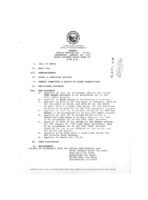
Meeting minutes for Consolidated Student Senate University of Nevada, Las Vegas, January 20, 1993
Date
Archival Collection
Description
Text