
Search Results

Interview with Michael Bordner, June 8, 2005
Date
Archival Collection
Description
Text

Transcript from interview with Sari and Paul Aizley by Barbara Tabach, November-December, 2015
Date
Archival Collection
Description
Paul and Sari Aizley discuss their many accomplishments as residents of Las Vegas, including those in education and with Jewish Family Service Agency.
Text

Transcript of interview with Dr. Leonard Kreisler by Barbara Tabach, May 23, 2016
Date
Archival Collection
Description
Dr. Leonard Kreisler, MD, was born August 3, 1930 in Brooklyn to post World War I European Jewish immigrants. Raised in the smaller community of White Plains, New York, he worked happily by his father?s side. The elder Kreisler was a cabinet maker and carpenter, who Len describes as fiercely independent. Young Len keenly helped his Yiddish language father write his contracts and guided him to increasing his prices. At an early age, Len knew that he would become a medical doctor?little did he know what an amazing life was in his future. It was while attending the University of Vermont, College of Medicine that Len met his wife Joan. They married in June 1957. Joan became a teacher and later a real estate agent while in Las Vegas. This interview includes stories about his medical education and his thirteen year private medical practice in Peekskill, New York. This was followed by a career in occupational medicine and over seventeen years as the Medical Director at the Nevada Test Site for Reynolds Electric and Engineering Corporation (1973 ? 1990). During that time he was also elected Chief of Staff at University Medical Center (UMC) for two years and helped create the Children?s Miracle Network Telethon and the UMC Foundation. When he recalls moving to Las Vegas, his memories include jogging by Temple Beth Sholom and joining a minyan. He became a congregation vice president. When his career at the Test Site was halted, his medical adventure led him to be a maritime physician for a cruise liner. He also ran twice for Clark County Commissioner against Thalia Dondero. Dr. Kreisler is the author of several books: Death by Any Means (2005); Roll the Dice, Pick a Doc and Hope for the Best (2009); The Codes of Babylon (2010); Shortfall (2011); The Obligated Volunteer (2014) and In Bed Alone, A Caregiver?s Odyssey (2016).
Text

Transcript of interview with Elizabeth "Betty" Krolak by Irene Rostine, September 26, 1995
Date
Archival Collection
Description
In 1962, Elizabeth “Betty” Krolak moved from the Midwest to Las Vegas with her husband and six children. Not only would the drier desert climate benefit her youngest daughter’s health due to asthma, but the family hoped the Las Vegas economy would be beneficial for their future. Prior to her arrival in Las Vegas, Betty worked briefly as a secretary for the New York Central Railroad before becoming a stay-at-home mom and active member of the PTA. Upon their arrival in Las Vegas, Betty’s husband enrolled in a real estate class, but was unable to complete the program. Betty, not wanting to waste the $80 they had spent on the class, decided to attend in his place. This decision led to life changing events for Betty and her family over the next four decades. After taking the real estate class and passing the test, Betty became a licensed Nevada real estate broker in October of 1963. She initially went to work for Pyramid Realty and, in 1964, she opened her own office, Clark County Realty. After her divorce in 1967, Betty was left with “six hungry children” to feed and no child support or health insurance. She recalls how the benefits of being in real estate really became apparent during this period of her life. While real estate required long hours seven days a week, it also afforded a single mother flexibility that other careers would not have offered. Likewise, a woman could make more money in real estate in the 1960s and 1970s than most other careers provided, which was particularly important for Betty who was committed to raising her children without public assistance. Betty’s oral history chronicles the growth of the Las Vegas Board of Realtors which has grown into what today is the Greater Las Vegas Association of Realtors (GLVAR). She recalls how, in the 1960s, meetings took place in bowling allies and the primary role of the GLVAR was to provide networking opportunities and represent the Code of Ethics for realtors. However, the Board was dominated by males, with the role of women members confined to planning social events and arranging for refreshments. In 1968, Betty and several other women realtors set out to change this by initially establishing a local Women’s Council within the Board. In the years following, Betty became the first women to be an Executive Board Member. Today, more than half the members of the Executive Board are women. Betty’s oral history also speaks to many changes within the real estate industry over the past four decades, some positive and some not so positive. She recounts the 1960s to the 1980s, when casino workers’ main source of income came from tips which were often unreported, creating challenges in getting casino workers qualified for home loans because they did not have the ability to document their source of income. Likewise, single women had a hard time qualifying for home loans because they only had one income and, in those days, it rarely was enough to qualify for a mortgage on their own. Also during this period, realtors primarily focused on the resale market because builders wanted to work directly with buyers, but changes in the real estate market eventually led builders to realize the benefits of allowing realtors to sell new houses, too. During her career, Betty also experienced the rise of real estate franchises, beginning with Century 21’s arrival in Nevada, the development of Multiple Listing Service (MLS), changes to educational requirements, approaches to settling disputes, and new approaches to ethics violations. Perhaps the biggest change Betty’s oral history speaks to is the personal approach to selling real estate that has been lost over time. In the early days, brokers sold houses right alongside the sales agents. Today, however, regulations have placed brokers in a position where their primary role is to manage sales people, not sell houses. Also, realtors used to interact with other realtors, title company personnel, and mortgage lenders before technology, such as fax machines and computers, came along. In the early days, documents were transferred in person allowing people in the industry to get to know one another through these personal interactions. Today, everything is done electronically and it is rare to actually know the person on the other end. Selling real estate has lost a lot of its personal touch, according to Betty. In addition to being the mother of six children and running one of the largest real estate offices in the area, Betty also found time to give back to the community through her volunteer work with the Salvation Army. She was instrumental in establishing Southern Nevada’s Angel Tree project, which provides Christmas presents to children who otherwise would not receive them. She was also appointed by Governor Michael O’Callahan to the State of Nevada’s Real Estate Commission, making her the first woman to serve on the Commission. Betty’s career in real estate allowed her to witness and implement many changes that still impact the industry today. When Betty began her career, Las Vegas’ population was just over 45 thousand. By the mid-1990s Green Valley, Spring Valley, North Las Vegas, Summerlin, and Sun City had been developed and the Valley’s population exceeded 1 million people. Betty Krolak’s career merged with the real estate boom as she helped find homes for those who wanted to make Las Vegas their home. She made sure the real estate industry’s growth included women, training mechanisms, and ethics which continue to benefit realtors, home buyers, and home sellers to this day.
Text
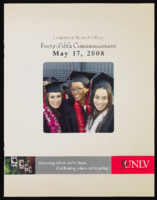
University of Nevada, Las Vegas (UNLV) 45th commencement program
Date
Archival Collection
Description
Commencement program from University of Nevada, Las Vegas Commencement Programs and Graduation Lists (UA-00115).
Text

Sylvia Alvarado interview, April 12, 2019: transcript
Date
Archival Collection
Description
Interviewed by Rodrigo Vazquez, Monserrath Hernández, and Barbara Tabach. Sylvia Alvarado talks about growing up in North Las Vegas and her Catholic upbringing in a Mexican household. Her studies in Journalism & Media Studies led her to her career as a radio host on English and Spanish-speaking programs. She also talks about speaking "pocha" Spanish and the Latinx influence in radio programming.
Text

Transcript of interview with Kenny Kerr by Dennis McBride, May 29 & 30, 2001
Date
Archival Collection
Description
In the years following this interview, Kerr continued entertaining, although he never returned to the Las Vegas Strip. Kerr performed at OUTfest Phoenix, at Palm Springs’ Awesome August celebrations, Las Vegas’ National Coming Out Day event, and for the Gay and Lesbian Community Center’s Youth Service’s Division. Kerr also gave shows at small bars and restaurants such as Café Nicolle and DeStefano’s in Las Vegas, the Wilde Goose in Cathedral City, California, and the Plush Room in San Francisco. There were rumors that Kerr was set to replace emcee Joey Arias in Cirque du Soliel [2004] and Frank Marino in La Cage [2005], but neither turned out to be true. Instead, Kerr performed in such local gay nightclubs as Flex, Sasha’s, Krave, Suede, and, on July 31, 2012, at the Onyx Theatre in Commercial Center. In 2006, Kerr made peace with his former rival, Frank Marino. Kerr’s son, Kristin Vidal, made Kenny a grandfather with his own son, Alexander. It was clear during his July 2012 performan
Text

David Ober interview, October 11, 2017: transcript
Date
Archival Collection
Description
Tucson, Arizona, native David Ober moved to Las Vegas twice. He arrived reluctantly the first time in 1978 with his parents as a high-school student, when his father, Hal Ober, came to Las Vegas to begin building and marketing the U.S. Home (now Lennar) brand. While the elder Ober soon left U.S. Home to open his own home-building business, R.A. Homes, his youngest child left Las Vegas shortly after his high school graduation to return to his native Tucson, follow in the footsteps of his siblings, and attend the University of Arizona. After graduating from the University of Arizona David Ober opened his own mortgage company and began building a life in Phoenix. In the late 1980s he agreed to take a large pay cut, return to Las Vegas, and learn his father's business from the ground up. At the time, Hal Ober was developing his award-winning, master-planned community, Desert Shores. David Ober, the youngest of the five children of Hal and D'Vorre (Dee) Ober, agreed to participate in the
Text

Transcript of interview with John L. Houck by Perry L. Smith, March 14, 1981
Date
Archival Collection
Description
On March 14, 1981, collector Perry L. Smith interviewed police officer, John L. Houck, (born May 11th, 1944 in Butte, Montana) in his home in Las Vegas, Nevada. This interview offers an overview of the history of Las Vegas and insider details on early Las Vegas police work. The interview concludes with a discussion on Henderson and Boulder City.
Text

Transcript of interview with Justice Michael Cherry by Barbara Tabach, September 19, 2014
Date
Archival Collection
Description
Interview with Justice Michael Cherry by Barbara Tabach on September 19, 2014. In this interview, Justice Cherry talks about how he came to Las Vegas and his work as a public defender and as a lawyer in private practice. He also discusses his involvement with Jewish organizations in various capacities, and his involvement with high-profile cases such as the MGM Grand and Las Vegas Hilton fires, earning him the nickname "master of disaster."
Justice Michael Cherry was born in St. Louis, Missouri, and went on to spend his childhood in the Jewish neighborhood of University City. He attended University of Missouri and became a leader in his fraternity, Alpha Epsilon Pi, and a committed ROTC cadet. By the time Justice Cherry graduated from Missouri and was heading to Washington University School of Law, he was a second lieutenant; halfway through law school, he was promoted to first lieutenant. It was also during law school that he married his college sweetheart, Rachel Wolfson. When a bad back prevented him from becoming an active air force officer, he and his wife decided to follow his mother to Las Vegas. Justice Cherry worked both as a law clerk with the Public Defender's Office as well as a security guard at Wonder World when he first moved to the city. After passing the Nevada bar, Cherry took at position with the Public Defender's Office, and later went into private practice as a successful criminal defense attorney. Cherry was elected as district judge in 1998 and 2002. In 2006, he won his campaign for state Supreme Court justice. Justice Cherry was reelected to office in 2012 for another four-year term. He is currently the highest-positioned Jewish official in the state of Nevada. Throughout his years in Las Vegas, Justice Cherry has been an extremely active and influential member of the Jewish community and served as chairman of the Anti-Defamation League and is active in the Jewish Federation. Justice Cherry attributes his commitment to service to his mother. In addition to his service to the Jewish community, he has been active in numerous other service organizations, including March of Dimes, Olive Crest, Adoption Exchange and American Cancer Society.
Text