
Search Results
International Food Service Executives Association Records
Identifier
MS-00305
Abstract
The International Food Service Executive Association (IFSEA) Records contain the organizational records from the IFSEA dating from 1916 to 2010. Included are meeting programs and minutes, menus, conference reports and proceedings, financial reports, newsletters, award certificates, scrapbooks, and stewards and caterers records focusing on the hospitality and food service industry. Materials are from both national and regional branches of the organization and include records from the United States military, with whom IFSEA has partnered with since the 1960s. Club artifacts and trophies are also contained in the collection.
Archival Collection
North Las Vegas Bicentennial Committee Photographs and Drawings of Kiel Ranch
Identifier
PH-00005
Abstract
The North Las Vegas Bicentennial Committee Photographs and Drawings of Kiel Ranch document the buildings on Kiel (Kyle) Ranch in 1974. As part of the commemoration of the United States bicentennial, the North Las Vegas City Council elected to restore Kiel Ranch, which was one of the first non-indigenous settlements in the Las Vegas Valley. The materials include black-and-white photographs of Kiel Ranch as it was in 1974 as well as architectural drawings of planned renovations to the main house, the Brown House, the foreman's house, and the ranch hands' house.
Archival Collection
Tonopah-Goldfield Mining Photograph Collection
Identifier
PH-00023
Abstract
The Tonopah-Goldfield Mining Photograph Collection depicts mining activities in the mining towns of Tonopah and Goldfield in Esmeralda County, Nevada from approximately 1901 to 1920. The photographs primarily depict mines, miners, mills, construction, ore, and workers transporting ore. The photographs also depict events and people in Tonopah and Goldfield, including parades, celebrations, banquets, children, Native Americans, and prominent buildings.
Archival Collection
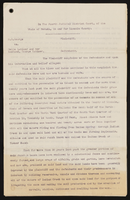
Notice of lawsuit: District Court
Date
1905-06
Archival Collection
Description
This folder is from "Legal Records" file of the Sadie and Hampton George Papers (MS-00434)
Text
Mabel Hoggard Papers
Identifier
MS-00565
Abstract
The Mabel Hoggard Papers (1903-2011) contain materials related to Hoggard's career as a Las Vegas, Nevada elementary school teacher, her research and civic interests in Las Vegas's predominantly African American Westside communities, and her engagement with civil rights issues. The collection also contains materials about Hoggard's life, including biographical newspaper articles about her childhood, education, work, and family. The collection includes lesson plans, scrapbooks, awards, correspondence, photographs, and physical objects such as a vinyl record and political pins. The bulk of the collection focuses on her life in Las Vegas from approximately 1946-1989.
Archival Collection

Transcript of interview with Suzette Cox by Lance Cooper, March 1, 1979
Date
1979-03-01
Archival Collection
Description
On March 1, 1979, Lance Cooper interviewed Suzette Cox (b. 1945 in San Diego, California) about her experiences living in Las Vegas, Nevada. Cox talks briefly about her career history in working at the Las Vegas Sun, as a deputy sheriff, and eventually as a secretary at the University of Nevada, Las Vegas. She also talks about the various parts of Las Vegas in which she has lived since moving to the city in 1953. The two also discuss the Las Vegas Strip, gambling, recreational activities, atomic testing, the Mormon Fort, and how Las Vegas has changed over the years.
Text
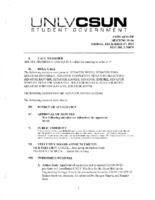
Meeting minutes for Consolidated Student Senate, University of Nevada, Las Vegas, December 17, 2004
Date
2004-12-17
Archival Collection
Description
Includes meeting minutes and agenda. CSUN Session 35 Meeting Minutes and Agendas.
Text

Nanyu Tomiyasu interview, March 11, 1978: transcript
Date
1978-03-11
Archival Collection
Description
On March 11, 1978, Sosuke Miyazawa interviewed Nanyu Tomiyasu (b. May 28, 1918 in Las Vegas, Nevada) about his family’s farm and their legacy as one of the pioneering families of the city. Tomiyasu begins by talking about what brought his family to Las Vegas, the city’s abundant water reservoir and his father’s farm. In particular, Tomiyasu discusses his father’s experiments with farming as one of the city’s early farmers, the transition into nursery farming and Japanese gardens. Moreover, he discusses his siblings, the local schools, their great quality, the successful students the city produced and the growth of school populations. Tomiyasu describes the large Japanese population and the Union Pacific Railroad that many of them worked on. He ends by discussing the change in architecture within the city, such as where old buildings stood and what they are used for now, the first Episcopal Church and the old Mormon Fort.
Text
San Pedro, Los Angeles & Salt Lake Railroad Company Records
Identifier
MS-00007
Abstract
The collection is comprised of records of the San Pedro, Los Angeles & Salt Lake Railroad Company (1901-1976). The construction of this railroad led to the founding of Las Vegas, Nevada and the creation of the Empire Construction Company and Las Vegas Land and Water Company. The records document the company's operations and include correspondence and contracts relating to lots in the Las Vegas townsite, payments and accounts, invoices and other audit materials from 1905 to 1923. The collection also includes the records of the railroad agent at Arden Station, located ten miles south of the Las Vegas Station, which contain correspondence, ledgers, freight and way bills, shipping orders, and telegrams.
Archival Collection