
Search Results
Transcript of interview with Dr. Ray and Linda Rawson by Claytee White, October 30, 2009 and November 13, 2009
Date
Archival Collection
Description
Raymond Rawson's life started in the rural Utah community of Sandy in 1940. His family moved around in what he describes as a scene from John Steinbeck's The Grapes of Wrath. By the age of 10, the family settled in Las Vegas, which had a population of around 35,000. He attended Fifth Street Grammar School, Las Vegas High School, was a member of UNLV's first graduating class, and eventually became a dentist. In this interview, he reflects on his experiences of growing up in Las Vegas, the hardships of difficult economic eras, and his professional accomplishments in the field of dentistry, including actively advocating the creation of UNLV School of Dental Medicine. Ray also became a community leader. He served in the Nevada State Legislature from 1985 to 2001. He talks about his relationship with long-time legislator Joe Neal. Education and access to healthcare were among the issues that Ray championed and he shares his observations of these issues. In 2009, he was appointe
Text
Transcript of interview with John Page by Lois Goodall, April 16, 2014
Date
Archival Collection
Description
John J. Page attended 13 schools before graduating from high school in the Ozark Hill Country of Oklahoma. Although he engaged in no combat, he was drafted into military after completing two years of college at the University of Oklahoma in Norman, Oklahoma. After his discharge from the U.S. Air Force, he helped his wife, Reitha, finish the credits she needed to complete her degree, and he then worked to complete his in Norman. Following his graduation, the couple relocated to Las Vegas in February 1959, when Reitha found a job at Washington Elementary School. In Las Vegas John completed his practice teaching under master teacher Lamar Terry at Twin Lakes Elementary School and under supervision of Dr. Holbert Hendrix at the University of Nevada, Las Vegas. John held his first teaching assignment, fifth grade at West Charleston Elementary School (later called Howard Wasden Elementary School), for 27 years before transferring with his principal to Helen Marie Smith Elementary School. For a time John and Reitha rented a small house at the comer of Bonanza Road and First Street that was owned by entertainer Horace Heidt. They bought their first house, a Pardee Park Home one block north of Tom Williams Elementary School in North Las Vegas, because Reitha taught there, and she and the children could walk to school together. In 1973 they bought their current house on El Cortez Avenue in the Westleigh tract. Page not only worked in Ward 1 for 27 years of his 36-year teaching career (1959-1995); he and his family also lived in Ward 1 for more than forty years. As a teacher in the school that served the wealthiest Las Vegas families, Page witnessed the many ways that generous donations of time, money, and talent matter to schools, students, and teachers. As an early resident of Westleigh tract, Page saw dramatic changes to the area's built environment. And as a longtime educator, Page observed several cycles of experimental instmctional techniques and philosophies.
Text
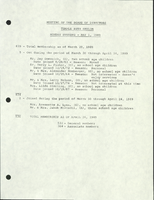
Minutes from Temple Beth Sholom Board of Directors meetings, June 1988 - May 1989 (1 of 2)
Date
Archival Collection
Description
Meeting minutes include reports from committees of the board, correspondence, and balance sheets.
Text

Interview with Harold Melvin Agnew, October 10, 2005
Date
Archival Collection
Description
Text

Interview with Nick C. Aquilina, June 25, 2004
Date
Archival Collection
Description
Text

Transcript of interview with Valerie Wiener by Barbara Tabach, January 20, 2015
Date
Archival Collection
Description
Valerie Wiener is an accomplished state senator, business owner, president and founding member of the Public Service Institute of Nevada and the Valerie Wiener Foundation. She was born October 30, 1948 in Las Vegas, Nevada. Her service as senator for 16 years and her role as a public servant led her to become the first woman assistant majority leader of the state senate in Nevada. She graduated with a bachelor degree of Journalism at the University of Missouri/Columbia within the School of Journalism earning a Masters of Arts in Broadcast Journalism and a Master of Arts in Literature at the University of Illinois in Springfield while attending law school at McGeorge School of Law in Sacramento in the 1970s. Her generosity is also seen through scholarships and activities at the Louis Wiener Jr. Elementary School. In addition, Valerie is a professional speaker, consultant, and internationally published author. She is the recipients of many awards, such as: ?Women of Achievement Award? in Media; ?Healthy Schools Heroes?; ?Public Affairs Champion Award?; ?Legislator of the Year?, and the Nevada Secretary of State?s recipient of the ?Jean Ford Participatory Democracy Award.? She stays active through her commitment to the Nevada Senior Olympics for both Fitness and Weightlifting earning 17 gold medals from 1998 to 2007. In this interview, Wiener discusses her childhood and being raised in Las Vegas in the 1950s as well as the academic path that led her career into politics. She shares memorable insight into the life of her father, Louis Isaac Wiener, Jr., an accomplished attorney and business man who represented the infamous Benjamin ?Bugsy? Siegel during the construction and opening of the Flamingo Hotel and Casino in 1946. Throughout Wiener?s interview, she highlights the traditions of the small, but growing Las Vegas Jewish population in the 1960s. Among the people she recalls most vividly is her grandmother Kitty Wiener. Wiener also discusses her community service work and her life mantra of giving.
Text

Transcript of interview with Robert "Bob"Agonia by Marcela Rodriguez-Campo, September 6, 2018
Date
Archival Collection
Description
Robert “Bob” Agonia (1938- ) was born in Garden Grove, California on a migrant camp made up of Filipino and Mexican-American workers. Agonia’s father was a farmer on a 70 acre farm owned by the Beggs family. Agonia did not spend much time living on the migrant camp, as his father moved the family to a private residence when Agonia was four. Agonia attended school, during an era of school desegregation in Garden Grove. He recalls that his mother dealt with segregation during her schooling, being forced to attend a school miles down the road from her home despite living across the street from another school. Agonia recalls his community being very diverse with families sharing Filipino and Mexican-American heritage and his neighbors being Japanese Americans. Agonia participated in a multicultural Boy Scout troop. After high school, Agonia joined the Peace Corps and served in El Salvador. While there, Agonia worked in an agricultural research center in Santa Tecla where he helped local farmers select the proper insecticide for their crops. After the Peace Corps, Agonia had his choice of government jobs, ultimately selecting to work for the Internal Revenue Service. Agonia’s work with the IRS is what eventually brought him from California to Las Vegas. He quickly realized that the type of IRS cases he would be handling in Las Vegas were completely different from the work he was accustomed to in California. One of those unique cases required him to close the doors of a downtown casino. Since moving to Las Vegas, Agonia was critical in establishing a Las Vegas LULAC chapter, an American GI Forum, an EEO council, and the UNLV Engineering school.
Text
Harmon Family Papers
Identifier
Abstract
The Harmon Family Papers consist of the political and personal correspondence of Las Vegas, Nevada pioneer Harley A. Harmon from 1910 to 1934, and his son, Harley E. Harmon, from 1950 to 1966. The collection also includes correspondence, personal papers, and photographs of Harley L. Harmon from approximately 1950 to 1999. Also included are family scrapbooks with wedding announcements, photographs, birthday cards, newspaper clippings, and other ephemera.
Archival Collection
Helen J. Stewart Photographs
Identifier
Abstract
The Helen J. Stewart Photographs depict the Stewart Family from approximately 1860 to 1950. The photographs primarily depict Helen J. Stewart and her children as well as the Stewart Ranch (also know as the Las Vegas Ranch) in Southern Nevada. The photographs include the early Las Vegas, Nevada town site, landscapes of Southern Nevada and the American Southwest, mines and mining camps, railroads and railroad workers, the Las Vegas Fort (also known as the Old Mormon Fort), hotels and early businesses in Las Vegas, Native Americans and Native American artifacts, and postcards.
Archival Collection