Search Results
Price, Margaret M., 1918-2006
Margaret M. "Maggie" Price, 88, of Boulder City, passed away Saturday, Sept. 16, 2006. She was born Sept. 27, 1918, in Freeport, Ill., and spent her childhood growing up in Columbus and Lebanon, Ohio. Maggie married Frank, a native of Columbus, Ohio, Feb. 3, 1938. They moved to Las Vegas in 1949. Maggie worked at the Sands Hotel as a showroom waitress during the "Rat Pack" era. She retired to take care of her daughter, Patti Kay. Years later, they moved to Boulder City.
Person

Transcript of interview with Stella Butterfield by Joanne Goodwin, October 14 & October 25, 2005
Date
Archival Collection
Description
Interviewed by Joanne L. Goodwin. Stella Butterfield's family, the Goldbergs, was Jewish, and she was born in the Bronx. During World War II she worked for the Coast Guard in the steno pool in Washington, D.C. Stella moved to Santa Monica a few years later while the war was still going on and worked briefly as a riveter for Douglas Aircraft and then as a teletype operator for the Air Force but at Douglas Aircraft. Because she had a hard time getting a job because of antisemitism, she changed her name to Gilbert. In December of 1948 she went to the Canal Zone in Panama to be the secretary of the commanding officer of the Panama Supply Depot. Stella was also a law reporter for court martials. She met Frank Butterfield, who was stationed there, and married him in 1952. He was transferred back to the United States, and they lived in Massachusetts. Then they moved to Los Angeles, and in 1953 they moved to Las Vegas, where she was a court reporter at Nellis Air Force Base. Then they moved to Mexico City, then back to California where she worked as a legal secretary. In early 1955 they moved back to Las Vegas, and Stella worked as a federal court reporter for Judge Roger T. Foley.
Text
Will Vicuna oral history interviews
Identifier
Abstract
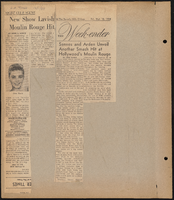
Oral history interviews with Will Vicuna conducted by Stefani Evans on June 23 and July 3, 2023 for Reflections: the Las Vegas Asian American and Pacific Islander Oral History Project. In the first interview, Vicuna goes into detail about his family's history, and his parents' life in Quezon, Philippines. When his brother sent Will a postcard of the newly opened Hilton Hotel and Casino, Will decided he would move to Las Vegas as soon as he completed his psychology degree in 1970. He concludes the first interview discussing his employment at the Hilton and the Flamingo Hilton, his 1972 marriage, and his 1973 UNLV graduation in Hotel Administration. In the second interview, Vicuna talks about his wife, Felicidad, who graduated from University of Santo Tomas (UST) in Manila in Medical Technology. He shares details about her career, and then talks about his own career in hospitality, working in a number of Las Vegas hotels including the Hilton and Flamingo Hilton, Palace Station, Peppermill Mesquite, and the Golden Eagle in Pahrump. Throughout the interviews, Vicuna discusses family reunions in Las Vegas, shopping for Filipino food, and eating at various restaurants around town. Digital audio available; no transcript available.
Archival Collection

Transcript of interview with Gary Sternberg by Barbara Tabach, February - April, 2015
Date
Archival Collection
Description
In this oral history, Gary explains how the family came to live in the United States?Cleveland and Los Angeles. In 1957, he married Noreen and they eventually came to live in Las Vegas where Gary worked for Sears selling washing machines, had a repair business and an importing business with Noreen. Gary was an entrepreneurial soul and inventive much like his father. He owns three patents.
On August 25, 1931, Augusta and Herman Sternberg welcomed their second child, Gerd (aka Gary), into the world of Cuxhaven, Germany. Augusta was a devout Christian of Polish ancestry who had fled Russian persecution. Herman was a German-born Jew salesman and inventor. The couple fell in love and had two children, Gary and Ruth who was a year and half older. By 1938, German politics were targeting Jews and Herman was ripped away from his Christian wife and children and sent to a concentration camp. Fate and friendship rescued Herman with the option to go to China. And so begins the history of the Sternberg family and how they all would eventually live together during World War II in the confines of a Jewish ghetto in Hongkew, China from May 1939 to July 1948. Gary had an extraordinary career as a dealer. He was not the stereotypical young dealer-to-be: he was in his 40s when he signed up for the Michael Gaughn Dealing School in the mid-1970s. Gary?s charming wit and ease of making friends soon gained him a position at El Cortez and then Caesars Palace. It was the same personality that would sustain his stellar thirty-one year career at Caesars. He was employed there from April 1974 until his retirement May 8, 2005. Though Jewish tradition would identify Gary as Christian, he self-identified as Jewish, officially converted and has been an active member of the Jewish community. Among his anecdotes-and he has many-is one about securing a $30,000 donation from Frank Sinatra and Jilly Rizzo for Congregation Ner Tamid.
Text