
Search Results
Transcript of interview with John Page by Lois Goodall, April 16, 2014
Date
Archival Collection
Description
John J. Page attended 13 schools before graduating from high school in the Ozark Hill Country of Oklahoma. Although he engaged in no combat, he was drafted into military after completing two years of college at the University of Oklahoma in Norman, Oklahoma. After his discharge from the U.S. Air Force, he helped his wife, Reitha, finish the credits she needed to complete her degree, and he then worked to complete his in Norman. Following his graduation, the couple relocated to Las Vegas in February 1959, when Reitha found a job at Washington Elementary School. In Las Vegas John completed his practice teaching under master teacher Lamar Terry at Twin Lakes Elementary School and under supervision of Dr. Holbert Hendrix at the University of Nevada, Las Vegas. John held his first teaching assignment, fifth grade at West Charleston Elementary School (later called Howard Wasden Elementary School), for 27 years before transferring with his principal to Helen Marie Smith Elementary School. For a time John and Reitha rented a small house at the comer of Bonanza Road and First Street that was owned by entertainer Horace Heidt. They bought their first house, a Pardee Park Home one block north of Tom Williams Elementary School in North Las Vegas, because Reitha taught there, and she and the children could walk to school together. In 1973 they bought their current house on El Cortez Avenue in the Westleigh tract. Page not only worked in Ward 1 for 27 years of his 36-year teaching career (1959-1995); he and his family also lived in Ward 1 for more than forty years. As a teacher in the school that served the wealthiest Las Vegas families, Page witnessed the many ways that generous donations of time, money, and talent matter to schools, students, and teachers. As an early resident of Westleigh tract, Page saw dramatic changes to the area's built environment. And as a longtime educator, Page observed several cycles of experimental instmctional techniques and philosophies.
Text
Transcript of interview with Jack Levine by Suzanne Becker, June 28, 2007
Date
Archival Collection
Description
Jack LeVine offers a narrative as a real estate agent and a gay man who has lived in Las Vegas since he was a young adult in the 1980s. He first started visiting Las Vegas whenever his truck driver routes allowed him to visit his parents who had moved here in 1977. They owned a downtown sandwich and catering business called Your Place or Mine. Then in 1985 Jack and his life-partner, J.J., decided to relocate to Las Vegas. Jack soon launched a real estate career that began with the purchase of a 13-unit apartment complex. Over the years he became knowledgeable about the history of the greater community and the individual neighborhoods; including John S. Park—"the earliest suburb in Las Vegas. Jack and J.J have lived in a 1954 Mid-Century Modern home since the mid-1990s. Jack is a strong believer in re-gentrification and mentions other cities where this has been successful. His philosophy includes an explanation of the sense of community that is derived from those who invest of themselves in that community life John S. Park.
Text

Interview with Jeannette (Jean) M. (Mactaggart) Crooks, July 21, 2004
Date
Archival Collection
Description
Text

Interview with Ann G. Dye, November 1, 2004
Date
Archival Collection
Description
Text

Interview with Anna (Anne) Welsh, June 23, 2004
Date
Archival Collection
Description
Text

Interview with Cecil C. Garland, July 19, 2006
Date
Archival Collection
Description
Text

Interview with Donna Smith, November 4, 2006
Date
Archival Collection
Description
Text

Transcript of interview with Cathie Millson by Anna Huddleston, June 10, 2014
Date
Archival Collection
Description
Cathie and Chris Millson moved to Las Vegas with their one-year-old daughter, Nicole, in 1984 following Chris’s completion of a cardio-thoracic anesthesiology fellowship in Atlanta, Georgia. Their two other children were born in Las Vegas. Shortly after they arrived they purchased the Rancho Bel Air house where they currently reside. Cathie talks about raising her children and living in Rancho Bel Air, a gated neighborhood of custom houses, which grew to maturity after the Millsons moved in. Cathie’s memories chronicle the growth of Las Vegas from small town to large city, how a certain segment of the population lived and entertained, and how downtown revitalization has brought young people back to Rancho Bel Air to raise their families.
Text
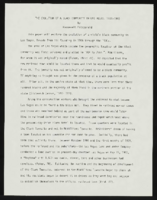
"The Evolution of a Black Community in Las Vegas: 1905-1940": manuscript draft by Roosevelt Fitzgerald
Date
Archival Collection
Description
From the Roosevelt Fitzgerald Professional Papers (MS-01082) -- Unpublished manuscripts file.
Text

Transcript of interview with Dorothy Pitzer by Judy Harrell, May 19, 2014
Date
Archival Collection
Description
Born in Chicago and raised in small Illinois towns, Dorothy Karper met her future husband, Doug Pitzer, when they went to rival high schools. She began nurses’ training in Dixon, Illinois, and immediately after her 1950 graduation, Dorothy and Doug married. Although he never had to go overseas, the Korean War interrupted their married life, and Doug enlisted in the Air Force and went to basic training in Texas. The couple arrived in Las Vegas in July 1954, when Doug was transferred to Nellis Air Force Base. Dorothy worked as a nurse at Las Vegas Hospital and Clinic 1954-1957 and later worked for a private obstetrics practice. From 1954 until Doug’s discharge in 1957 the Pitzers lived in Kelso-Turner Terrace military housing. In 1956 they purchased a new house in Twin Lakes, but they didn't move in until 1957, after the streets were put in. They remained in their Twin Lakes house until they moved into Dorothy’s present house on Burton Avenue, between West Charleston Boulevard
Text