
Search Results
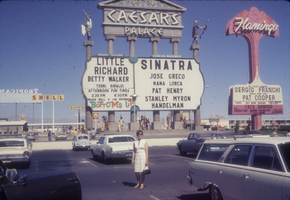
Slide of the Caesars Palace marquee, Las Vegas, 1969
Date
Archival Collection
Description
Image
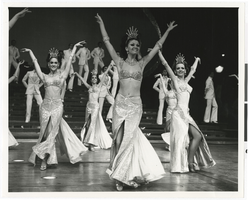
Photograph of showgirls performing in Lido de Paris at the Stardust Hotel, Las Vegas (Nev.), 1977
Date
Archival Collection
Description
Show Name: Lido de Paris (Las Vegas, Nev.)
Site Name: Stardust Resort and Casino
Image
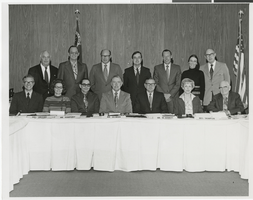
Photograph of Regents, Las Vegas, 1950s - 1960s
Date
Archival Collection
Description
Image

Transcript of interview with Alice Ward Boyer by Joanne Goodwin, June 26, 1996
Date
Archival Collection
Description
Alice Ward Boyer arrived in Las Vegas from Oklahoma in 1937. Her brother and former husband came earlier to escape the dustbowl depression and get settled. In the middle of the summer, just at dusk, she emerged from the train at Kingman, Arizona with her two small children to meet her family and drive through the darkness to her new home in Las Vegas. Although she missed the trees of the Plains, she soon became accustomed to her desert home. Her recollections revive the older Las Vegas when community life characterized the small town. At the heart of her story is the Mesquite Club. The non-partisan civic activities of the Mesquite Club are part of a national history of women’s club voluntarism in the nineteenth and twentieth century United States. Founded in 1911, this pioneer Las Vegas women's club played an essential role in the development of the growing town. When few cultural or social services existed, the club raised funds for the first public library, developed parks for the city, and provided services and funding for the aged and youth. The Mesquite Club, along with the Parent Teacher Association, scouts, and church activities formed a network of community relations commonly found in developing towns and cities, but not ususally associated with Las Vegas. Alice Boyer joined the Mesquite club in 1944. She first served as the chair of the Garden Committee, then "went right up through the chairs," and was elected President of the club for 1958-59. (See Table of Offices Held). Speaking about the Mesquite Club founders, Alice Boyer said, “They were very forward-looking women. They knew that the town would grow and they wanted the best for the town.” As one of the second generation of members, she has found the club to be a continuing source of congenial social life and civic community building. Born in rural Oklahoma, she spent her early years on a ranch. Her parents met there shortly after "the run to open Oklahoma" around 1892. They met, married and had twelve children, nine of which survived. Alice came right in the middle. She spent her early years riding horses, wearing “overalls," and spending as much time as possible outside. The family moved into Clinton, Oklahoma for better schools for their children when she was in the fifth grade. Alice graduated from high school just as the Great Depression began and worked briefly at a newspaper before marriage. At the time of the interview, Alice Boyer’s vivaciousness, gracious manner, and sharp memory belied her 82 years. This interview has been produced with the assistance of the Mesquite Club and the History Department of the University of Nevada, Las Vegas. It is part of a series on women community builders in Las Vegas. The transcript has been edited only slightly for clarity while the syntax and style of the narrator were retained.
Text
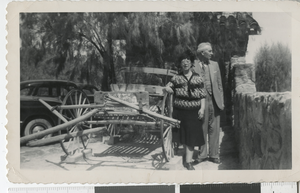
Photograph of Laura and Curtis Stewart at Furnace Creek Inn, Death Valley (Calif.), 1949
Date
Archival Collection
Description
Image
Linda Miller Papers
Identifier
Abstract
The Linda Miller Papers (2008-2025) document Dr. Linda Miller's historic preservation work in Las Vegas, Nevada including her work portraying early Las Vegas resident, Helen J. Stewart, at historical events across Southern Nevada. The collection documents Miller's efforts to erect a statue of Helen Stewart at the Las Vegas, Nevada Old Mormon Fort, as well as her contributions to the programming for Sarah Winnemucca Day in 2018. The collection documents Miller's appearances as Helen J. Stewart through photographs, pamphlets, video recordings, digital files, and curriculum used for her outreach work. The collection also documents Dr. Miller's activities as chair for the Nevada State Society chapter of the National Society of the Daughters of the American Revolution (NSDAR) and as a member of the National Society Sons and Daughters of the Pilgrims Southern Nevada Chapter.
Archival Collection
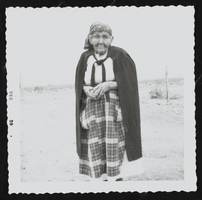
Photograph of Native American elder, Pahrump (Nev.), December 1959
Date
Archival Collection
Description
Image

Transcript of interview with Florence McClure by Joanne Goodwin, January 24, 1996 & February 6, 1996
Date
Archival Collection
Description
Florence McClure came to Las Vegas later in her life, but the state felt her presence and the community her contributions as if she were a native daughter. Introduced to the League of Women Voters in 1967, McClure met her political mentor Jean Ford and learned how to practice the core elements of democracy. She put those tools to work in a number of ways, however her participation in the creation of the Rape Crises Center and her advocacy for locating the women’s prison near Las Vegas are two of her long-lasting efforts. Florence Alberta Schilling was born in southern Illinois where she enjoyed the security of a tight-knit family and the independence to test her abilities growing up. She graduated from high school and attended the MacMurray College for Women at Jacksonville. With the attack on Pearl Harbor in 1941, she began a series of jobs working for the war effort. She moved to Ypsilanti, Michigan with a girlfriend to work at the Willow Run Army Airbase and then moved to Miami, Florida where she worked for the Provost Marshall in the Security and Intelligence Division. She met her husband, James McClure, at the time and they married in 1945. During the next several years, they raised a family and moved around the country and to Japan with the military. McClure came to Las Vegas in 1966 as part of her work in the hotel industry which she engaged in after her husband’s retirement from the military. She had worked in California and Miami Beach, but it was Burton Cohen in Los Angeles who invited her to join him in a move to Las Vegas to build the new Frontier Hotel and Casino. Following the completion of the Frontier, she moved to the Desert Inn with Cohen in 1967 and worked as the executive office manager. After a few years, she decided to leave the industry and complete her college education. She graduated from UNLV in 1971with a BA in Sociology with an emphasis on criminology. She was 50 years old. McClure had been a member of the League of Women Voters for a few years at that point and had learned the political process from Jean Ford and workshops on lobbying. She had numerous skills that were waiting to be tapped when she attended an informational meeting on the incidence of rape in the Las Vegas valley. From that meeting, a small group of individuals, including McClure, began the organization Community Action Against Rape (later renamed the Rape Crisis Center) in 1973. It was the first agency in the area devoted to serving individuals who had been assaulted and changing the laws on rape. The organization’s first office was set up in McClure’s home. Over the next decade, she worked to change attitudes and reshape policy by constantly raising the issues of sexual assault with police officers, emergency room doctors, judges, and legislators. Her role as an advocate took her into hospital emergency rooms and courtrooms to assist victims. It also took her to the state legislator to lobby repeatedly for a change in laws. During this period, journalist Jan Seagrave gave McClure the nickname “Hurricane Florence” - a fitting moniker that captured the force with which McClure attacked the issue. As a result of her efforts and those of the people with whom she worked, we now 1) recognize rape as a crime of assault; 2) forbid the sexual history of a rape victim from being used against her in court; and 3) recognize marital rape. In addition to learning about Florence McClure’s activities, the reader of this interview will gain information on the role of civic organizations like the League of Women Voters in engaging the voluntary efforts of women in the post-war years.
Text
Freda Klein Papers
Identifier
Abstract
The Freda Klein Papers (1967-1997) include a detailed biography and personal reflection penned by Klein, as well as a photocopied scrapbook. The scrapbook is comprised of correspondence and newspaper clippings that detail her career with the State of Nevada Employment Security Department and volunteer work with the Henderson Chamber of Commerce, Private Industry Council, and Soroptimist International of Henderson, Nevada.
Archival Collection
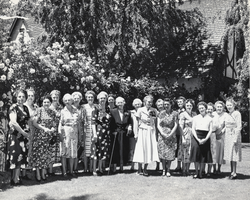
Photograph of a women at the U-Wah-Un Study Club, Las Vegas, circa 1930s to 1950s
Date
Archival Collection
Description
Image