
Search Results
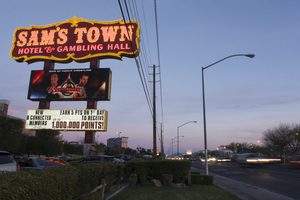
Photographs of Sam's Town sign, Las Vegas (Nev.), March 7, 2017
Date
Archival Collection
Description
The Sam's Town Hotel and Gambling Hall sits at 5111 Boulder Highway. Information about the sign is available in the Southern Nevada Neon Survey Data Sheet
Site name: Sam's Town (Las Vegas, Nev.)
Site address: 5111 Boulder Hwy
Sign owner: Boyd Gaming
Sign details: Sam Boyd came to Las Vegas in the late 40's early 50's and went to work in the Downtown casinos. He moved quickly through the ranks and was overseeing many operations. His son studied law and coupled with him, Sam Boyd created Boyd Gaming in 1975. Sam's Town opened April 1, 1979 which was named after the company's patriarch. This was one of the first Resorts to cater to locals.
Sign condition: 5- Very good condition
Sign form: Super Pylon and many smaller Port Cocheres.
Sign-specific description: The background of the sign is Red with a yellow/gold trim, "Sam's Town" is in channeled white lettering. The font as well as the gold trim on the sign show the Old West and Frontier style. This sign contains a LED video board as well as a reader board.
Sign - type of display: Neon, LED video board, reader board and Incandescent light bulbs.
Sign - media: Steel and plastic
Sign - non-neon treatments: Reader board and LED screen
Sign animation: Flasher for incandescent light bulbs
Sign environment: This location is on Boulder Hwy just minute's drive from Arizona Charlie's. There are RV parks and various chain restaurants close to this casino.
Sign - thematic influences: It keeps it tradition with western cowboy theming that has been popular in Las Vegas.
Sign - artistic significance: With this Western theme it has remnants of the gold rush and 49er's type aesthetic.
Survey - research locations: Sam's Town https://www.samstownlv.com/ , Correspondence with Boyd gaming. Boyd Gaming website https://www.boydgaming.com/about-boyd-gaming .
Surveyor: Wyatt Currie-Diamond
Survey - date completed: 2017-08-18
Sign keywords: Pylon; Porte-cochère; Neon; Incandescent; Flashing; Reader board; Steel; Plastic; Video screen
Mixed Content
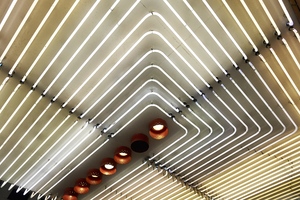
Photographs of Binion's signs, Las Vegas (Nev.), April 18, 2017
Date
Archival Collection
Description
The Binion's Gambling Hall and Hotel, bought in 1951 as the Horseshoe Club, sits at 128 Fremont Street inside the Fremont Street Experience. Information about the sign is available in the Southern Nevada Neon Survey Sheet.
Site name: Binion's Horseshoe (Las Vegas, Nev.)
Site address: 128 Fremont St
Sign owner: TLC Casino Enterprises
Sign details: Opened By Benny Binion 1951, and later say remodels and expansions in 1960 after the purchase of the Boulder Club and 1988 when The Mint was purchase and expanded further and doubled the size. Mr. Binion is known for popularizing the World Series of Poker and brought the game into the mainstream. Binion's Horseshoe was the first casino to put carpeting in a downtown property.
Sign condition: 5 - all of the neon on the property is well maintained and working
Sign form: Concave design, Bullnose elements and decorated shed
Sign-specific description: The property is currently known as Binion's. The horseshoe elements of the property were removed when the Casino changed the name in 2004. The property is a decorated shed, with blue neon signs covering the exterior of the building. The property also has neon signs with the name "Binion's" in a cursive font around the building, along with a large "B" and the world "Gambling" in a western style serif font
Sign - type of display: Neon and Incandescent
Sign - media: Steel
Sign animation: Flickering incandescent bulbs, neon tubes in-between the solid blue flicker.
Sign environment: Downtown Las Vegas, across from Golden Nugget
Sign manufacturer: YESCO and AD-Art
Sign designer: Rudy Crisostomo
Sign architect of record: 1961
Sign - date of installation: 1961
Sign - date of redesign/move: 2005 rebranded as Binion's Gambling Hall
Sign - thematic influences: Similar to other properties on Fremont Street. Property is wrapped with neon and has elements of western flair in the design
Sign - artistic significance: 1960s Downtown started to see the first decorated sheds, and the western style casino was still popular during that time.
Survey - research locations: The Magic Sign, Binion's website, Vintage Vegas
Survey - research notes: https://lasvegassun.com/blogs/kats-report/2010/jan/12/rooms-dark-there-still-action-binions/
Surveyor: Wyatt Currie-Diamond
Survey - date completed: 2017-09-11
Sign keywords: Neon; Incandescent; Steel; Flickering; Bullnose; Architectural
Mixed Content

Transcript of interview with Toni Clark by Joanne Goodwin, July 2, 1996
Date
Archival Collection
Description
Toni Clark (born Lena Gaglionese) spent her youth in Seattle, Washington where she was born on April 4, 1915 to Angelene and Salvatore Gaglionese. Her father and mother moved to the Seattle area when they immigrated to the United States from Naples, Italy years earlier. Salvatore worked as a street cleaner for the city of Seattle and Angelene cared for the house and family until her early death. Toni grew up with three siblings, her father and step-mother, and an uncle and cousins next door. After attending Seattle’s Franklin High School for three years, she left. “I just didn’t like school so I quit,” she said, and spent the next couple of years at home. From these simple origins, Toni became “the first lady of Las Vegas” as some admirers called her, referring to the role she played in the transformation of Las Vegas from a frontier town into a glamorous resort town during the 1950s and 1960s. In 1941, before the Second World War began, Toni traveled to San Diego to visit friends and decided to stay. After a year of caring for a young boy, she moved into the Barbara Worth Hotel which was owned by Wilbur Clark. Clark’s father ran the hotel and suggested that Toni apply for a job at his son’s new bar and restaurant, the Monte Carlo. She had not met Wilbur Clark at the time and her shyness dissuaded her from making the move. Nevertheless, she did apply and went to work as the hostess of the Monte Carlo in downtown San Diego. Wilbur and Toni’s courtship began slowly. He gave her the name Toni, saying she “looked more like a Toni than a Lena,” and she kept it. In 1944, around the time Wilbur Clark relocated to Las Vegas where he had purchased the El Rancho Hotel, the couple married in Reno, Nevada and permanently made Las Vegas their home. Clark’s involvement in Las Vegas clubs and gambling expanded with the Monte Carlo downtown and the Player’s Club on the strip. But his dream to create a luxury resort hotel came to fruition when the Desert Inn opened in 1950. The fifth major property on the strip, the Desert Inn had several features that distinguished it from other places. The Skyroom offered a private club atmosphere for talking, music, and dancing. The Monte Carlo Room served French cuisine. The Doll House provided round-the-clock childcare for children of hotel guests. The Painted Desert Room, the property’s showroom, featured top performers and the Donn Arden Dancers. All these features combined to create a resort that offered guests an exquisite setting for a gambling vacation. Toni Clark had a special place at the heart of the Desert Inn’s social life. She brought a gracious and elegant charm to social events associated with the property. Although she said she was never involved in the business of the hotel-casino, she played a unique role setting a new tone for the enterprise. She entertained guests and dignitaries at the hotel as well as her home; organized fashion shows featuring the top designers of the time for the wives of high-rollers; and created celebrations of special events, notably her husband’s late December birthday, with annual parties. When Wilbur Clark died in 1965, Toni Clark remained active in the city’s social life. She did not disappear as others had, but continued to plan and attend social functions. As part of her service to the community, she took particular pleasure in her work with the Variety Club. She continued to reside in Las Vegas until her death in 2006.
Text

Photographs of Mermaids Casino signs, Las Vegas (Nev.), June 24, 2016
Date
Archival Collection
Description
Site address: 32 Fremont St
Sign owner: Derek and Greg Stevens
Sign details: Shutdown in 2016, opened briefly June 28th, 2017 for 8 hours to abide by gambling license law, was torn down shortly after. 2.76 acre lot, originally built in 1949.
Sign condition: Signage was removed from building during deconstruction
Sign form: Decorated shed
Sign-specific description: Covering all the sides of the Mermaids facing Fremont street, gives the feel of New Orleans during Mardi Gras with its bright vibrant colors, drums, maracas, and other items. Skeleton neon was used to accentuate features of the sign like details in the drums, outlining the word "Mermaids", and a good portion of the sign was internally lit as well. Giant TV screen hung in the middle at the corner of the building, giant Sun shaped pinata thing above the TV screen adding more to the theme.
Sign - type of display: Neon, LED screen
Sign - media: Steel and fiberglass
Sign - non-neon treatments: LED screen
Sign animation: Animated with an LED TV screen and some neon would flash on and off
Sign environment: Downtown on Fremont Street, part of the Experience. Surrounded by other casinos and gift stores.
Sign - date of installation: c. 1999
Sign - date of redesign/move: Torn down Summer 2017
Sign - thematic influences: Southern party themed, Mardi Gras.
Sign - artistic significance: American South and Mardi Gras.
Survey - research locations: Vital Vegas, Assessor's website
Surveyor: Danny Jacobs
Survey - date completed: 2017-09-09
Sign keywords: Neon; Steel; Fiberglass; Flashing; Video screen; Sculptural
Mixed Content
Pair A Dice Mobile Home Park Neon Survey document, September 12, 2017
Date
Archival Collection
Description
Site address: 2067 N Las Vegas Blvd
Sign owner: Peyman Masachi and Pair A Dice Estates LLC
Sign details: Originally construction was in 1956 for a Manufactured Homes park. This location offers 137 spaces for mobile homes and have 42 permanent parked homes.
Sign condition: 3.5- paint has faded drastically
Sign form: Pylon
Sign-specific description: This pylon has 2 plastic back lit red dice on the top of it with the one on top with the number 5 and the lower one reads 2 to make the lucky number 7. To the non-road side of this double sided sign is a yellow circle plastic back lit sign that has painted black letters stating "Pair A Dice". Below this is an orange triangle shape that has channeled neon white steel letters near the top of it stating "Trailer Park" in a block type font that illuminate white at night. Below these letters are a white plastic back lit sign stating "R.V.'s Welcome" with their phone number posted underneath. Below is another plastic back lit sign that is yellow with a black font stating "Senior Park". Below this is a skeletal neon arrow that points to their driveway that illuminates yellow at night.
Sign - type of display: Neon and plastic back lit signs
Sign - media: Steel and plastic
Sign - non-neon treatments: Plastic Back lit portions
Sign animation: Chasing, flashing, oscillating
Notes: The logo cabinets which adorn the entrances on the elevated walkways: The letters start with both rows of text in the off position. The top row flashes on, while the bottom row is dark then the bottom row illuminates, as the top row goes dark. Once the top row flashes off it flashes back on so that both rows of text are briefly illuminated simultaneously before they both go dark and the sequence stars over again. While this is going on the incandescent bulbs which line all of the raceways are chasing each other from left to right on the horizontal planes, while the arched sections chase each other downward. The triangular peaks which radiate around the top of the logo sign, flash on and off in a sequence which chase each other downward. First the top center peak flashes on, then the next sequential triangular channel on both sides illuminate simultaneously, flash off, then the next two in the series illuminate. The resultant effect is a chasing pattern starting from the top. The sister animation is located on almost the exact same design on the porte cochere. I would think the previous smaller sign would be based on the larger porte cochere. The other variance besides obvious size difference is the that the channel letters are filled with incandescent bulbs instead of neon. The animation is a bit simpler as well. The incandescent bulbs oscillate continuously while the triangular pan channels which create the radiating crown, animate. The neon in the channels chase each other as described in the smaller walk way version, while the text continues until the entire text flashes off, then on, off, then begin to animate once again. All of the bulbs, which line the raceways of the exterior edge of the porte cochere, as well as the encrustation of bulbs on the brass bull nose portion, animate in rapid succession. All the raceway bulbs chase each other while the bulbs on the brass portion continually oscillate. Animation continues on the east face of the building with the entrances first. The principle for these two signs is oscillation and chasing. All bulbs on the underside of the entrance, as well as in the logo, oscillate rapidly. All bulbs on the raceways chase each other. Further on the surface of the building as well, the Pepsi cola wall sign is found displaying a very unique form of animation, seen here on the strip. The signage for the Pepsi ad is located on the eastern wall. (Detailed in specific description) The Incandescent bulbs which fill the inside of the text that spells Pepsi, chase each other from left to right, leaving all the bulbs in its path illuminated, as if writing out the word Pepsi. The neon bars located within the tilted bottle of Pepsi are illuminated, and chase each other downward, leaving the bars it its path dark. As this sequence in taking place, the waving tubes of neon illuminate, flashed subtly making the neon appear as soda pouring out of the bottle. As the tubing flows then the vertical neon bars in the cup illuminate one at a time making the cup appear as if it is filling up. The text above each of the painted fires head, flashes back and forth as if talking to each other as well. ESPN ZONE animation: The letters in the vertical blade portion of the ESPN Zone illuminate one at a time, starting from the top. Once the entire phrase is lit, in flashes off then on then off, before restating. The orange and red neon tubing which resides inside the pan channels that represent flames flash on and off in a relaxed manner as if to animate the flickering of the flames. The small incandescent bulbs on the black portions above the main matrix reader board flash on and off subtly.
Sign environment: This location is in North Las Vegas along Las Vegas Blvd. It is north of Jerry's Nugget by about a mile.
Sign manufacturer: There is a marking for "BMS" on this sign which is a sign manufacturer in Minneapolis, Minnesota but could not get in contact with anyone to see if this is the correct manufacturer/maintainer or if it had a different meaning.
Sign - date of installation: Has been up since at least 2007 but does look a lot older than that
Sign - thematic influences: The triangle in this sign does have a mid-century modern theme (50's/60's) to it with curved geometric shapes.
Sign - artistic significance: The theme of Pair A- Dice plays perfectly with the theme of Vegas since for many table dice games you need a pair of dice. Though you are also in paradise here in Vegas particularly since the incorporated area of Vegas which we all know as the strip is technically the city of "Paradise". Also the Pair O' Dice was the name of one of the first casino's down on the strip when gambling was re-legalized in the state of Nevada in 1931.
Survey - research locations: Assessor's Page, Loop Net- Information on what the property offers http://www.loopnet.com/Listing/18840376/2067-N-Las-Vegas-Boulevard-Las-Vegas-NV/ , _Las Vegas Sun article https://lasvegassun.com/news/2011/mar/01/2-southern-nevada-contractors-file-bankruptcy/_, google maps satellite and roadside view
Survey - research notes: With the BMS sticker on this sign, it could be a sign company but the only one found online was in Minnesota. Unless if there was a BMS in Las Vegas but was bought out by a bigger sign company.
Survey - other remarks: The Pair A Dice LLC company went bankrupt in 2011 which this Las Vegas Sun article discusses https://lasvegassun.com/news/2011/mar/01/2-southern-nevada-contractors-file-bankruptcy/
Surveyor: Emily Fellmer
Survey - date completed: 2017-09-12
Sign keywords: Neon; Plastic; Backlit; Steel; Roadside
Text
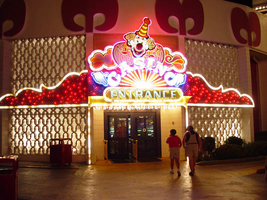
Photographs of Circus Circus signs, Las Vegas (Nev.), 2002
Date
Archival Collection
Description
Site name: Circus Circus (Las Vegas, Nev.)
Site address: 2880 S Las Vegas Blvd
Sign owner: Mandalay Resort Group
Sign details: Circus Circus is a cluster of signage and buildings located toward the Sahara Boulevard. When approaching Circus Circus on Las Vegas Boulevard from the North or the South the first thing which is seen is Lucky the Clown, the giant, sculpted, roadside pylon, on the west side of the strip where the property is located. From the South as you approach the property A small double backed marquis sign for the Circus Circus is perched atop the corner or the shared and neighboring establishment of the Slots-a-fun's small street side covering. As you make you way past to entrance to Slots of Fun toward the Giant Lucky sign, the impressive porte cochere comes into view. The porte cochere is the centerpieces for the flankings of the electrified north elevation of the low rise Slots a fun building and the Lucky the Clown Pylon. Following the building North and around it's North elevation, and elevated tram track is exaggerated by the striping of red neon and incandescent bulbs. From there you see the letters horizontally along the high rise towers spelling Circus Circus. The rear of the property serves as home to the Circus Circus Manor, an RV park for the recreational motorist to stay in their travels.
Sign condition: Structure 4 Surface 4 Lighting 5
Sign form: Pylon; Fascia; Porte-cochère
Sign-specific description: The first description belongs to the double backed color LED message center. The board is outlined in rose neon leading up into neon scrollwork center-pieced at the very top of the sign by a smiling clown face. Between the message center and reader board are the animated neon words circus circus in channel lettering with red neon. When facing the front of the Circus Circus, the first fixture, which catches the eye, is the dazzling Rudy Coristomo designed porte cochere. The gradually arched cover is of fully cantilevered design, and the entire piece is encrusted with a dizzying array of animated red and white incandescent bulbs. The words Circus Circus are spelled in channel lettering cross the front peak of the low rise arch design. The letters are filled with white animated incandescent bulbs. A backdrop for the porte-cochere is the pattern of incandescent bulbs along the wall of the structure, which supports the porte cochere. Painted in animated bulbs, narrow, intersecting archway designs reach from the ground nearly to the top of the building itself. The effect is nice backdrop, which leads the eye from the wings of the property to the center. Placed just to the left of the Porte cochere is an entrance into the casino. Above the door a neon and bulb encrusted fascia designed clown holds guard to the word entrance spelled in backlit plastic. Flanking the figure itself are animated red and white bulb laden scrollwork. To the right of the porte cochere is a smeller yet equally charming sign representing another entrance into the building. The smiling backlit plastic wall sign, like the previous, holds an arched text of casino which itself sits above the word entrance. It is outlined in blue neon, with animated incandescent bulbs. Two backlit plastic message boards with changeable vinyl lettering join the wall sign. Animated incandescent bulbs form a border around each. Following around to the North side of the building. A continuous stripe of red neon and a stream of incandescent bulbs border an elevated tram path. As it disappears into a higher elevation building, the giant, vertical, red neon letters Spelling Circus Circus can be seen high above along the east elevation of the tower in the near distance. Continuing west you arrive in the rear parking lot where several items of signage reside. At the very west edge of the property a single sided arched backlit panel faces east and is supported by two candy striped red and white poles. Following the striping and forming a border around the arched panel, white incandescent bulbs chase around the entire sign. In a two-leveled section of text, in the very center of the top of the sign, the words Circus Circus and then Entrance below that are spelled in metal channel lettering with exposed red neon on the interior. On either side of the red neon text are the words free parking painted in white. Directly through the gate further in the distance in the Parking lot, the parking garage can be seen highlighted by the vertical channel lettering, in block text the words Free parking on the west elevation and on the north elevation the key circus circus turn of the century lettering spell circus circus lighted with red neon. The words light up in sequence back and forth in animated turn, saying Circus, Circus. Below that Free Parking is also spelled in block text channel lettering, with exposed red neon. Along the north side of the parking lot is Circus Circus Manor, the recreational vehicle park is highlighted with it's own unique signage.
Sign - type of display: Neon; Incandescent; Backlit; Matrix
Sign - media: Steel; Plastic; Fiberglass
Sign - non-neon treatments: Graphics; Paint
Sign animation: Oscillating, flashing
Sign environment: The site is bordered on the South by Slots of Fun, on the north by the Hilton timeshare under construction, and across the Strip by the Riviera.
Sign manufacturer: YESCO (porte and pylon)
Sign designer: Rudy Crisostomo/LeeLinton (Porte cochere) Dan Edwards (Lucky the Clown Pylon)
Sign - date of installation: Pylon: 1976, Porte Cochere: 1983
Sign - date of redesign/move: The back-lit plastic message board of Lucky the Clown was replaced with an LED matrix screen. In 1983, the porte cochere was redesigned by Rudy Crisostomo and architect Lee Linton.
Sign - thematic influences: The Circus Circus is entirely encompassed by the theme of the big top extravaganza of the three ring circus. The furiously animated light arrays, sheer magnitude of the number of bulbs, intensity of light, all add to the exciting concept of the circus. The turn of the century fonts, reminiscent of the Barbary Coast block Style, are mostly consistent through out the property.
Sign - artistic significance: This theme was en effort to give a bit more respectable image to gambling originally in the late sixties and early seventies. They would incorporate live aerial acts over the casino floor The unique concept was accented by a higher capacity for staying travelers and more family oriented attractions. The giant backlit sculpted pylon Lucky the Clown sign stood as a standard for size and dominance. The 84 ton steel structure was all internally contained and lit from head to toe and welcomed guests and was on of the most memorable Las Vegas sign experiences. Artistically it was influential on the standard on how a resort could be totally encompassed by a theme to create a unique spectacular for most people as well as retain the brilliance of Las Vega's garish style.
Surveyor: Joshua Cannaday
Survey - date completed: 2002
Sign keywords: Oscillating; Flashing; Pylon; Fascia; Porte-cochère; Neon; Incandescent; Backlit; Matrix; Steel; Plastic; Fiberglass; Graphics; Paint
Mixed Content