Search Results

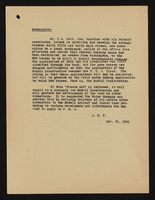
Alpha Kappa Alpha Sorority, Theta Theta Omega Chapter regional conference report
Date
Archival Collection
Description
From the Alpha Kappa Alpha Sorority, Incorporated, Theta Theta Omega Chapter Records (MS-01014) -- Chapter records file.
Text

Carol Frey oral history interview: transcript
Date
Archival Collection
Description
Oral history interview with Carol Frey conducted by Claytee D. White on March 30, 2018 for the Remembering 1 October Oral History Project. In this interview, Carol Frey discusses her work as a volunteer for the Trauma Intervention Program (TIP) of Southern Nevada. She specifically talks about the October 1, 2017 mass shooting in Las Vegas, Nevada and her volunteer efforts at one of the hospitals, where she provided support for survivors of the shooting, answering any questions they had, calling family members, arranging transport of loved ones to Las Vegas, and any other assistance that was needed, either emotional or practical. Throughout the interview, Frey discusses the moments that have stuck with her, including the gestures of gratitude the TIP volunteers had received from United Health Care employees and Sandy Hook High School students.
Text
Jane McCarthy oral history interview
Identifier
Abstract
Oral history interview with Jane McCarthy conducted by Claytee D. White on November 06, 2006 for the UNLV @ 50 Oral History Project. In this interview, McCarthy discusses her involvement with the University of Nevada, Las Vegas (UNLV) College of Education and their outreach program with the Navajo Nation. She explains that UNLV professors visit the reservation and offer graduate classes to teachers. McCarthy describes the reservation she visited, doing her sabbatical on the reservation in 2002, and the challenges that come with teaching Navajo children. Later, McCarthy recalls how she became involved with the Accelerated Schools Project, starting her career at Stanford University, and the differences between Stanford and UNLV. Lastly, McCarthy talks about the No Child Left Behind Act and the shortage of teachers in the Clark County School District (CCSD).
Archival Collection

Andres Dominguez oral history interview: transcript
Date
Archival Collection
Description
Oral history interview with Andres Dominguez conducted by Marcela Rodriguez Campo, Laurents Bañuelos-Benitez, and Barbara Tabach on February 11, 2019 for the Latinx Voices of Southern Nevada Oral History Project. In this interview, Dominguez discusses his upbringing in Las Vegas, Nevada and growing up on the Eastside. He talks about the history of barbering in his family, and his path to becoming a barber. Dominguez describes the process of acquiring the barbershop at the El Cortez Hotel and Casino, and the significance of the location to his family. Lastly, Dominguez discusses his perspective on life, the importance of networking, and his decision in naming his shop Speakeasy Barbershop LV.
Text

Daniel A. Moore interview, March 3, 1979: transcript
Date
Archival Collection
Description
On March 3, 1979, Norwood Germany Jr. interviewed Daniel A. Moore (b. 1939 in Fort Worth, Texas) about his life in Las Vegas, Nevada. Moore begins by speaking about his move to Las Vegas from Utah at a young age, his education and his work in construction and at the Las Vegas McCarran Airport. Moreover, Moore speaks about his involvement with church and his recreational hobbies such as bowling. Moore also spends time speaking about the African American population in Las Vegas, the jobs available to them, racial tensions in his young adulthood versus his children’s experiences, and the segregation of black communities into the Las Vegas Westside. Lastly, he talks about the city’s growth, tourism and the economy, the development of different shopping centers and malls, and the city’s law enforcement.
Text

Sook-ja Kim, February 12, 1996 and April 6, 1996: transcript
Date
Archival Collection
Description
The Kim Sisters, composed of three sisters, Sook-ja, Ai-ja, and Mia, came from Korea to Las Vegas in February 1959. Their first contract in America was to perform at the Thunderbird Hotel for four weeks as part of the China Doll Revue, the main showroom program. This engagement led to a successful career. Their popularity reached was at its height at the end of the 1960s when they performed throughout the United States and Europe. Sook-ja Kim is the oldest of the sisters. After his sister Ai-ja died in 1987, Sook-ja teamed up with her two brothers and continued to perform until 1989. Now semi-retired from show business, with occasional performances in Korea, she is working as a real estate agent. In this interview, she talked about her childhood, her career, and the family she has built since coming to America. Sook-ja was born in 1941 in Seoul, Korea as the third child of seven in a musical family. Her father was a conductor and her mother, a popular singer. After the Korean War, her mother arranged to send the Kim Sisters to America. When they came to Las Vegas, there were virtually no Koreans in the area. They depended on each other to take care of themselves. Some of the difficulties they had to adjust to in American were language, food, and cultural differences. Over the span of almost forty years in America, Sook-ja became acculturated without discarding her ethnic identity of family priorities. Her life-long guiding principle has been to adopt certain American values while continuing to keep her cherished Korean ethnic values. Through their performances, the Kim Sister informed the audience about Koreans and their culture. As the oldest of the group, Sook-ja was entrusted the care of her sisters, and later her brothers, the Kim brothers. Once she settled in Las Vegas, she brought more than forty members of her extended family to the city, contributing to the growth of the Las Vegas Korean community.
Text