Search Results
Judith Harriman and Mary Laub oral history interview
Identifier
Abstract
Oral history interview with Judith Harriman and Mary Laub conducted by Stefani Evans on October 31, 2017 for the Boyer Early Las Vegas Oral History Project. In this interview, Harriman and Laub discuss their early life and early interest in service organizations. They talk about the establishment of the Assistance League of Las Vegas (ALLV), organizing fundraisers, and philanthropic projects they were involved in. Harriman and Laub describe how ALLV has worked with school children in Las Vegas, the formation of Assiteens Auxiliary, and the formation of Desert Sage Auxiliary.
Archival Collection

LeMoyne Legere interview, March 17, 1977: transcript
Date
Archival Collection
Description
On March 17, 1977, collector Cecilia Branch interviewed LeMoyne Legere (born in 1935) at her residence in Las Vegas, Nevada. In this interview, Mrs. Legere discusses various differences in Las Vegas from the time she was growing up to the date of the interview. She also discusses her involvement in high school and what people do for recreation.
Text
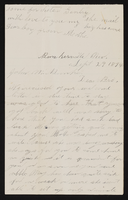
Letter from Francis M. Bunker and John M. Bunker's Mother, Bunkerville, Nevada to John M. Bunker
Date
Archival Collection
Description
From the Syphus-Bunker Papers (MS-00169). The folder contains an original handwritten letter, a typed transcription of the same letter, and a copy of original letter attached.
Text
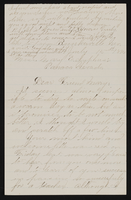
Letter (no envelope) from John M. Bunker, Bunkerville, Nevada to Mary E Syphus, Panaca, Nevada
Date
Archival Collection
Description
From the Syphus-Bunker Papers (MS-00169). The folder contains an original handwritten letter, a typed transcription of the same letter, and a copy of original letter attached.
Text

Transcript of interview with Roscoe Wilkes by Claytee White, March 19, 2009
Date
Archival Collection
Description
Roscoe Wilkes was born in Bonanza, Colorado, and moved with his family to Pioche, Nevada for what his sister called a 75-year pit stop. Soon after their move to this rural Nevada town, Roscoe’s mother became a widow, raising two children during the Depression. Like many families in Pioche, the Wilkes’ made due with what they had, and were creative in sustaining their livelihoods. Roscoe has never stood still. Before enlisting in the military, Roscoe worked various jobs, as a PBX systems operator, a lead zinc miner, and grade school teacher, before enlisting. During World War II, Roscoe became a prisoner of war in Romania, and was rescued a few months later when the Germans began retreating. Returning to the United States after his release, he relocated to a base in California, and married. As soon as Roscoe was relieved of his military service, he took advantage of the then new G.I. Bill and enrolled in the University of Southern California School of Law. He immediately took his degree to Pioche, soon becoming its district attorney, and later a judge. He spent 18 years based in Seattle as a federal administrative law judge, hearing cases prosecuted by the Coast Guard. Roscoe ended his 45-year career in law in 1990, and moved to Boulder City, where four generations of Wilkes live.
Text

Transcript of interview with Mike, Fred, & John Pinjuv by Barbara Tabach, May 13, 2014
Date
Archival Collection
Description
Mike Pinjuv sired one of Las Vegas’s early families after arriving in 1917. Mike Pinjuv arrived in Las Vegas via the Union Pacific Railroad and brought Ivan Pinjuv and his family to town (although Mike’s sons do not know the familial relation between the two men). Mike and his wife, Frances Malner, raised six sons and two daughters to adulthood through World War 1, the Great Depression, and World War II. The oldest five brothers attended Las Vegas High School, while Fred, the youngest brother, and the two sisters attended Rancho High School. In this interview, their three younger sons recall how they, their parents, and their siblings navigated the social and physical changes in the Las Vegas landscape. Over the near century that the Pinjuv family has lived in Las Vegas its members have contributed to the city in countless ways. In the early years Mike owned a gas station and a grocery store and worked several jobs before going to Nellis Air Force Base as a civilian. Of the Pinjuv sons
Text