
Search Results
Jamey Stillings Photographs
Identifier
Abstract
The Jamey Stillings Photographs (2009-2024) is primarily comprised of photographs taken by professional photographer, Jamey Stillings documenting various infrastructure projects in the region. The Mike O’Callaghan-Pat Tillman Memorial Bridge project at the Hoover Dam depicts the construction of the Mike O’Callaghan-Pat Tillman Memorial Bridge from 2009 to 2012. The Ivanpah Solar Electric Generating System project depicts aerial views of Ivanpah Solar in the Mojave Desert of California from 2010 to 2014. The Crescent Dunes Solar project consists of a range of aerial and ground-based work documenting SolarReserve's Crescent Dunes Solar near Tonopah, Nevada, from 2014 to 2015. The
Archival Collection

Transcript of interview with Pamela Gale by Margaret Louis, July 10, 1995
Date
Description
Text

Transcript of interview with Richard Erbe by Marcela Yepes, March 19, 1978
Date
Archival Collection
Description
On March 19, 1978, Marcela Yepes interviewed Richard Erbe (born 1922 in El Monte, California) about his experiences in Las Vegas, Nevada and specifically about his career in education. Erbe first talks about his family background and German ancestry before describing how he ended up moving to Nevada. He then describes his wife’s father’s background in the gaming industry and some of the early illicit casinos that existed in California. The interview shifts to Erbe’s educational background, his first teaching position as a fifth grade teacher, his experience in the military, and his reasoning for not seeking employment in the gaming industry. The two also discuss church activity, politics, and social activities in Las Vegas. The latter part of the interview includes Erbe’s viewpoints on the issues in the educational system, his experiences as a principal at multiple Clark County schools, and some of the challenges he encountered in the administrative side in the field of education.
Text
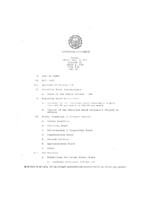
Meeting minutes for Consolidated Student Senate, University of Nevada, Las Vegas, March 6, 1984
Date
Archival Collection
Description
Text

Interview with Stephen Craig Ronshaugen, November 26, 2004
Date
Archival Collection
Description
Text

Meeting minutes for Consolidated Student Senate, University of Nevada, Las Vegas, February 28, 2000
Date
Archival Collection
Description
Text
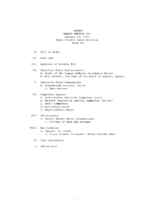
Meeting minutes for Consolidated Student Senate, University of Nevada, Las Vegas, January 30, 1979
Date
Archival Collection
Description
Text

Transcript of interview with Christopher Maestas by Claytee White, September 14, 2008
Date
Archival Collection
Description
Christopher “Chris” Maestas (1965-2009) was an engaged educator and leader within the Chicano, Latinx, and Henderson communities. As he traced back his Latinx heritage, he explored his father’s hometown in Llaves, New Mexico, where he and his family were discriminated for their non-white demeanor; and his mother’s paternal Spanish roots; his grandfather came to work in Henderson, Nevada at the Basic Magnesium Industrial (BMI) plants during World War II. The Chicano and Spanish cultures played a significant part in defining his role within the community. For Chris, Chicanos were “people that lived in the southwestern United States particularly southern Colorado, New Mexico and northern Arizona that were originally Mexican citizens before the treaty (Treaty of Guadalupe Hidalgo) was signed and then after the treaty was signed they became Americans.” In this interview, he dives into the difference between Chicano and Spanish cuisine and gives his own tips on how to make Spanish chile relleno. Chris discussed what life was like in Henderson living in Henderson Camp when his grandfather emigrated from Spain in 1943. He described the evolution of the Henderson community in the 50s through his parents’ experiences living in the Hispanic communities of Victory Village and Carver Park. During his childhood in the early 70s, Chris recalled living in Henderson when it was known as Basic and living in a small town-site house. One of his most special recollections was from the summer of 1980, when his family purchased their first set of air-conditioning units. As a passionate teacher and 1984 alumnus from Basic High School, he advocated student engagement as Student Council Advisor. Chris was also an active member of the St. Peter the Apostle, Catholic Church, Knights of the Columbus group and LUPE (Latinos United for Perfect Equality) Club. The LUPE club promoted equality for the Hispanic community and family values. Chris described their Saturday picnics at BMI Park and the annual Henderson Industrial Days festival.
Text