
Search Results

Transcript of interview with Billy Paul Smith by Claytee White, October 3, 2013
Date
Archival Collection
Description
Chemist, mathematician, and health physicist Billy Paul Smith donates time to tutor young people in hopes of attracting more youth into the fields of math and science. Born in 1942 and schooled in segregated black schools in Shreveport, Louisiana, and Texarkana, Texas, he graduated from high school at age fifteen and enrolled at Prairie View A&M University, where he trained with the Reserve Officer Training Corps (ROTC) and earned his Bachelor’s degree in chemistry and in 1964 his Master’s degrees in chemistry and math. Most young U.S. Army officers in 1964 went to Vietnam, but Billy’s math and science background steered him to the Army Chemical Corps, where he was quickly selected to join a new team. The team was to develop responses to nuclear weapon accidents and worked under the Defense Atomic Support Agency (DASA) in Albuquerque, New Mexico. At the same time, Billy completed the Weapons Ordinance Army course on classified information relating to the U.S. nuclear weapons arsenal. In this interview, Billy talks about his service with DASA and his subsequent twenty-seven years working at the Nevada Test Site in a variety of positions with Reynolds Electrical and Engineering Company, Inc. (REECo), a company that had “percentagewise more blacks in management positions than any other [Las Vegas] company.” He experienced the quiet racism of Las Vegas residential segregation when he tried to purchase a house in a neighborhood he liked and the unexpected kindness of the REECo general manager, Ron Keen, who made sure the Smith family could live where they wanted to live. He talks about Area 51 and explains underground testing activity and offers the scientific and ecological reasons why scientists deemed Yucca Mountain safe to store nuclear waste. After retiring at fifty-two, Billy and a colleague formed an independent instrumentation company, which, from 1995–2005 provided and calibrated radiological measurement and detection instruments for the decommissioning and closure of the Rocky Flats nuclear plant in Golden, Colorado. During that time, Billy rented an apartment in Boulder, but he and Jackie maintained their Las Vegas home, where they still reside. Billy shares memories of places he and his wife used to enjoy on the Westside and tells of their longtime friends in the black community. He also talks about developing his philosophy of philanthropy through Alpha Phi Alpha Fraternity and discusses becoming a member of the Knowledge Fund Advisory Council for the Governor’s Office of Economic Development (GOED) and the advisory council for the Nevada System of Higher Education.
Text

Greg Phelps oral history interview: transcript
Date
Archival Collection
Description
Oral history interview with Greg Phelps conducted by Claytee D. White on November 15, 2017 for the Remembering 1 October Oral History Project. Greg Phelps discusses moving to Las Vegas, Nevada in 2002 for work and attending the 2017 Route 91 Harvest festival with his mother and wife. He describes the event venue as well as his recollection of the shooting. Phelps explains how his life changed after that day, describing the true friendships he gained and his greater appreciation for living.
Text
Economic Opportunity Board of Clark County (Nev.) monthly reports
Date
Archival Collection
Description
From the Clark County Economic Opportunity Board Records -- Series I. Administrative. This folder contains monthly reports from various program coordinators to the Economic Opportunity Board of Clark County, Nevada from 1971 through 1973
Text
Meeting minutes for Consolidated Student Senate University of Nevada, Las Vegas, March 10, 1988
Date
Archival Collection
Description
Text
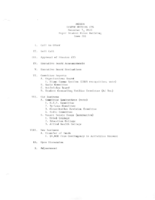
Meeting minutes for Consolidated Student Senate, University of Nevada, Las Vegas, December 05, 1978
Date
Archival Collection
Description
Text

Maria Benítez oral history interview: transcript
Date
Archival Collection
Description
Oral history interview with Maria Benítez conducted by Monserrath Hernández and Maribel Estrada Calderón on June 21, 2019 for the Latinx Voices of Southern Nevada Oral History Project. Maria Benítez is the image of a hardworking and determined Salvadoran woman. After facing adversity amidst the Salvadorian Civil War she talks about her journey as a nurse in El Salvador and migrating to the United States. Here in Las Vegas, she has worked as a cook on the Strip, been an active member of her church, and supported the education of her children selling pupusas. Subjects discussed include: El Salvador, Salvadorian Civil War, Migration, US Citizenship Documentation, and Judaism.
Text

Transcript of interview with Liliam Lujan Hickey by Layne Karafantis, March 18, 2010, & March 25, 2010
Date
Archival Collection
Description
Liliam Lujan Hickey is best known in the state of Nevada for being the first Hispanic woman elected to the State Board of Education as well as for the enormous contributions she made while serving from 1998 to 2000. For this, an elementary school in Clark County bears her name. Despite many obstacles, Liliam has continually dedicated herself to standing up for the causes she believes in, such as providing preschool education to the underprivileged, preparing youth to enter the workforce, helping other Hispanics run for office, and proving that with enough courage anyone can accomplish their dreams. Born in Havana, Cuba in 1932, Liliam led a sheltered life that revolved mostly around her studies at a French Dominican school. She met her first husband, Enrique Lujan, when she was only sixteen and they wed soon after. Enrique was twelve years her senior, owned many casinos on the island, and provided a luxurious existence for Liliam and their three children. However, this lifestyle abruptly changed when Castro assumed power in 1959 and Liliam and her family were compelled to relocate to the United States. In Miami, Enrique assisted other refugees financially, hoping that his wealth would remain secure in Cuba. He was wrong. This left the family destitute. In addition to casinos, Enrique had been Cuba?s coach for the Olympics. He moved the family to York, Pennsylvania, where he hoped to find work at the York Barbell Company. Liliam, who had been accustomed to having maids and nannies in Cuba, found herself doing all the housework while she also worked in a factory. The change could not have been more dramatic and the living conditions became unbearable. The family chose to move to San Diego in a Volkswagen Minivan with the hope for a better life. The next few years brought many transitions. Things did turn around in San Diego, and Liliam she recalls her years in southern California as some of the happiest of her life. Liliam found a job working at the Scripps Clinic in La Jolla. After a few years, Enrique found a job in Las Vegas and the family moved again. In Las Vegas, Liliam gave birth to her fourth child, Mary, and life once again became financially difficult for the family. In 1972, the situation grew worse with Enrique?s untimely death. Liliam was a widow at forty years of age. She had to teach herself how to drive a car, write checks, and perform financial tasks that Enrique had insisted on managing while he was alive. Determined not to give up, however, she worked tirelessly to keep the family together. Amidst all this, a friend introduced Liliam to Tom Hickey, and after a brief courtship they were married in 1981. Within a few years, Liliam became active in politics, running for the State Board of Education. Her campaign manager advised her that voters would not be receptive to photos of a Hispanic woman on billboards, and to capitalize on the name “Hickey,” which was a recognizable name because her husband was an assemblyman. She took the manager?s advice and was elected in that campaign and for two more terms, the maximum limit for the office. After the first race, she proudly displayed her face on billboards across the state. During her time at the State Board of Education, Liliam dedicated herself to helping all children receive a better education in Nevada, not only Hispanics. She co-founded the Classroom on Wheels [COW] program, which brought buses to poor neighborhoods to provide pre-school education. She established Career Day, which pairs high schools students with business professionals in an effort to help them make the transition into the workforce. While the COW program is no longer running, 8 Career Day still operates and awards scholarships in Liliam?s name annually, which helps youth receive the educational opportunities they need to succeed. And she involved Hispanic youth in Boy Scouts by bringing ScoutReach to the Las Vegas valley. Lujan Hickey worked in a wide array of other community organizations. In the 1970s, she began to work with Circulo Cubano, which later became the Latin Chamber of Commerce, and she would later belong to the National Chamber of Commerce. A longstanding member of the League of Women Voters, Liliam saw the need to get Hispanics more involved in politics in the state. Her story is one of great inspiration, and when asked why she does it, she simply replies with a smile, “I love life.” Hickey?s narrative offers the reader a glimpse of the experiences of the Cuban refugee experience in the U.S. in general. Specific to Las Vegas, it provides a rare story of the experiences of early Latinas in the political and economic development of Las Vegas in the last half of the twentieth century.
Text