
Search Results

Transcript of interview with Sandra Peña by Lada Mead and Stefani Evans, March 27, 2017
Date
Archival Collection
Description
Sandra Peña’s story begins in East Los Angeles, where she spent her first fifteen years with her parents (both from Michoacán, Mexico), and her younger sister. The father's managerial position at Master Products allowed the family to live rent-free in a company-owned house behind the main factory, because he collected the rents for the company's two other dwellings. In this interview, Peña recalls the family move to Porterville, in California's Central Valley, her return to Los Angeles at nineteen, and her work with Parson’s Dillingham, a contractor for the Metrolink rail system. She draws the link between the Los Angeles and Las Vegas construction communities by describing her husband's move to Las Vegas to find work; a chance Las Vegas encounter with a friend from Chino, California; her ability to gain employment in Las Vegas at Parson’s, a company that had joint ventured with Parson’s Dillingham, and her move from there to Richardson Construction, a local minority-owned company. As Peña says, "It's kind of all intermingled. Even if you go here and you go there, it's like everybody knows everybody." Throughout, Peña weaves her family story into the narrative as she describes her youth, the birth of her son, the illness and death of her father, and her family's participation in her current employment with Richardson. As she remembers the people, places, and events of her life, Peña speaks to the ways one woman of color built on her interstate construction connections and rose in a male-dominated industry.
Text

Transcript of interview with Joy Snyder by Lisa Gioia-Acres, December 17, 2009
Date
Archival Collection
Description
Joy Snyder, born and raised in Pennsylvania, is the daughter of Jean Dasinto and stepdaughter of Ray Hunt. Though she was raised thinking she was an only child, she shares that as an adult, she was contacted by an aunt who gave her information about an Austrian half-sister. The half-sister had tracked the family through WWII records on her biological father! Joy was raised in a very large extended Italian family (her maternal grandmother was first-generation Italian) and became the first in her family to attend college. She had decided early on that she wanted to be a nurse and chose to attend Temple University Hospital in Philadelphia. She recounts memories of her earliest work there, which began the first week of school. After graduation from nursing school, Joy married her childhood sweetheart, William (Bill) Snyder. They made the move to Las Vegas in 1978 and Joy found work right away at Desert Springs Hospital. She worked there about six months and then took maternity leave after the birth of their second son. When she returned to work, it was at Sunrise Hospital (early 1979) in the newborn nursery. Joy comments on many aspects of her career, including the informal approach to health care, the effects of desert climate on mothers and newborns, and the changes she has seen at Sunrise Hospital. She also comments on adoption practices in Las Vegas, drug-addicted babies, and cultural attitudes that appear during the birthing process. Today Joy is retired and her husband Bill is close to retiring. They feel a strong connection to Las Vegas (Bill has a school named after him), but maintain a second home in New York for their trips back East to visit friends and family. They also keep up with various community activities, including book clubs and running clubs for the children at William Snyder Elementary School.
Text

Jessica Hutchings oral history interview: transcript
Date
Archival Collection
Description
Oral history interview with Jessica Hutchings conducted by Barbara Tabach on March 21, 2018 for the Remembering 1 October Oral History Project. In this interview, Jessica Hutchings discusses her experience flying to Las Vegas, Nevada on the night of the October 1, 2017 mass shooting. She speaks of her flight's detour to Phoenix, Arizona, and her discovery of the shooting. Hutchings explains how Congregation Ner Tamid, where she is a cantor, contributed to the community healing after the tragedy, including their organization of vigils, a music fundraiser called "Vegas Strong in Song," and discussing the event with teenage Hebrew School students who had questions and concerns about the shooting.
Text

Economic Opportunity Board of Clark County (Nev.): memos, agendas, and meeting minutes
Date
Archival Collection
Description
From the Clark County Economic Opportunity Board Records -- Series I. Administrative. This folder contains memos, agendas and minutes from meetings of the Clark County Economic Opportunity Board from July 1969 through December 1969
Text
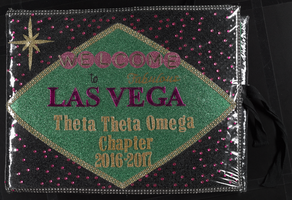
Alpha Kappa Alpha Sorority, Theta Theta Omega Chapter scrapbook: "Welcome to fabulous Las Vegas"
Date
Archival Collection
Description
From the Alpha Kappa Alpha Sorority, Incorporated, Theta Theta Omega Chapter Records (MS-01014).
Mixed Content

Transcript of interview with George Pollak by Claytee White, May 25, 2010
Date
Archival Collection
Description
George was raised in Mattapan, a suburb of Boston, by his mother and father. George had four siblings and was the second youngest. George shares fond memories of growing up and playing softball and tennis in the neighborhood park with his numerous friends. George could listen to a song on the radio and play it on the piano by ear when he was as young as four years old. George had several jobs to earn money growing up, including working in a record store and as a busboy. Eventually George and his brother joined a trio with Steve Harrington and performed in clubs. In 1958, George joined his brother and Paulette Richards in Las Vegas where they had a contract to play at El Rancho Hotel & Casino where they played until it was destroyed by fire. Following the fire, George and his brother parted ways and each did their own thing. In the 1960s, George began playing with the band at Caesars Palace. George used his background in accounting to do some bookkeeping and payroll for some of the ban
Text
Transcript of interview with Dennis Ortwein by Claytee White, May 6, 2009
Date
Archival Collection
Description
Dennis Ortwein arrived in Las Vegas in 1956. He shares many details about growing up in Montana, his parents and siblings, his education, and the moment in time when he was offered an opportunity to work in Las Vegas. He also lays out the path his singing career took, starting with school plays, duets with his sister, and high school quartets. Once in Las Vegas, Dennis taught for a while, served as principal, and was involved in creating programs that helped integrate schools. He also talks about his church choir work, entertainment in early Las Vegas, above-ground testing at the Nevada Test Site, and anti-nuclear protests. Dennis served as lab school and student teaching coordinator in Nigeria. He offers several anecdotes and stories about the time he and his family spent there. After retiring early (age 53), Dennis acted as consultant to the Esmeralda County school board, executive director for the National Conference of Christians and Jews, and wrote a book. He is currently enjoying his singing career by appearing at conventions, in musicals, and at weddings and memorials.
Text

Transcript of interview with Dayvid Figler by Barbara Tabach, June 22, 2016
Date
Archival Collection
Description
Dayvid Figler (1967 - ) is the quiet boy who became an insightful and creative contributor to the local culture of Las Vegas. The oldest of Barbara and Meyer Figler?s three children, he was four years old when the family station wagon reached Las Vegas in 1971. They moved in with Uncle Izzy (aka Big Irish) Figler for a few months. Having the ?juice,? Dayvid?s father soon became a Pan dealer on the Strip. As the family grew, Barbara eventually immersed her energies in her children?s activities, Hadassah and Temple Beth Sholom. In this oral history, Dayvid also recalls his awkward, but incredibly interesting youth, his bar mitzvah at Temple Beth Sholom, and path to a successful career as a criminal defense attorney. He also talks about embracing Las Vegas as his home, owning a home in John S. Park neighborhood and mentions a number of literary depictions of Las Vegas that he admires. Dayvid describes growing up a ?casino kid? who lived in an apartment near the Riviera Hotel. This, in addition to his slight stature and academic brilliance, may have set him apart from many of his childhood peers. He graduated from Valley High School at the age of 16 and by the age of 23 he was a rising star in the legal world. He looks back with appreciation to his list of mentors who encouraged him along the way. Dayvid is also a local favorite as an essayist and poet. For a number of years he could be heard on KNPR/NPR. He has been a performer in hundreds of productions that featured his comic wit and writings, from Lollapalooza to Tom and Jerry?s on Maryland Parkway.
Text