
Search Results
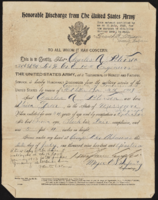
Father: Charles A. Peterson, US Army discharge papers [WWI]
Date
Archival Collection
Description
Series 1. Personal -- Subseries 1.1 Donn Arden
Text
Latin Quarter (New York): contract (typescript) between Donn Arden and E.M. Loew
Date
Archival Collection
Description
Series 2: Nightclubs
Text
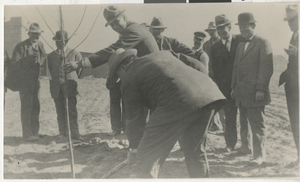
Photograph of people planting first tree in the courthouse park, Las Vegas in March 1911
Date
Archival Collection
Description
Image
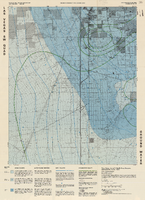
Topographic map of groundwater in the southwest quadrangle of Las Vegas, Nevada, 1985
Date
Description
Text
Transcript of interview with Ruth Poirier by Joanne Goodwin, February 5, 2003
Date
Archival Collection
Description
In 1927, a sixteen-year-old girl from Rockford, Illinois moved to New York City to play trumpet with the all-girl bands common from the 1920s through the end of World War II. During this period, which spanned Prohibition, the Great Depression, and World War II, all-girl bands came into their own in America. They were especially popular during the war, when most men were off fighting but people still needed and appreciated music. This was also a time when jazz and swing became wildly popular in this country. All-girl bands were able fill a niche left empty by men at war. Doris Eloise Pressler was born in Jamesville, Illinois on January 17, 1911 to Bertha Hendrich Pressler and Louis Pressler. Almost immediately after her birth, the Pressler family moved to Rockford, Illinois. Bertha was a teacher, a homemaker and mother. Louis did auto body hand-painting and also managed a bar. In addition, he played baritone saxophone and taught his daughter Doris to play trumpet. They both performed with hometown bands, playing churches, dances, and other social events. In 1927 at age sixteen, Doris left school, moved out of the family home, and went to work for Walgreens in downtown Rockford. In her free time she played music. Doris began her professional music career in 1927 as a trumpeter with the Gypsy Sweethearts in Rockford. That same year, she moved to New York, where she played in the only women’s band that ever performed at New York’s historic Roseland Ballroom. During the early 1930s, Doris performed with the Red Dominos, an all-girl band that was part of a variety show produced by E. K. Nadel. However, it was tough for girl musicians during the Depression. Few managers wanted to hire female players when so many men were out of work. Doris persevered, and through the 1940s, she traveled and played with other all-girl bands such as Annette Demon and her French Dolls and the Hollywood Debs. While Doris pursued her music career, a little girl in Wisconsin was learning to play the piano and trombone. Born on April 13, 1917, Ruth Poirier came from a musical family: her father John played drums and French horn, her brother drums and bassoon. John performed with the local Elks Club group, while Ruth and her brother played for their high school band. Ruth’s mother Mary had been a nurse, so when she finished high school Ruth decided to attend nursing school in Chicago. After a year, she returned home to Wisconsin and trained as a beautician. In 1939, Ruth answered a local ad for girl musicians and signed on as a trombonist with an all-girl band. Her first gig lasted only a month, the band dissolved, and she left to tour with Annette Demon and her French Dolls out of Milwaukee. While playing down South, Ruth met a fellow musician who became her lifelong companion, Doris Pressler. In July 1939, Ruth and Doris took off for Southern California. While living in Long Beach, Doris performed with bands at the 660 Club on the Pike, a well-known waterfront amusement park, and at the Waldorf Cellar. She also played a gig at Murphy’s, across from the Showboat in Las Vegas. Girl musicians began getting more jobs because the men were being called into military service. Ruth, a “Rosie the Riveter” during the war years, helped to build Navy fighter planes for Douglas Aircraft in El Segundo, California. After the war ended in 1945 women, whether “Rosie the Riveters” or band members, lost their jobs to the hordes of returning servicemen. Realizing that all-girl bands were “gonna go nowhere at all,” Doris had decided in the early 1940s to return to school and pursue studies in her second love, mathematics. She took classes in math and engineering at the University of Southern California, and then joined the Los Angeles County surveyors’ department as a civil engineer. After two years there, Doris transferred to the road department, where she worked until her retirement in 1974. Ruth returned to work as a beautician, running a shop out of her home. The Greater Los Angeles area contained an active gay and lesbian community both during and after the war. Doris and Ruth enjoyed a social life that included girls’ clubs such as Tess’s and drag clubs like the Flamingo. According to Ruth, these were “sitting-down, drinking places…and visiting. We had one club where they had dancing…. But then they let everybody in.” After the war, everybody just wanted to have fun, and Doris and Ruth enjoyed getting together with all types of friends in clubs and in private homes. During these at-home evenings, Doris and others would play popular music for everyone’s enjoyment. After their retirement to Las Vegas in 1974, Doris and Ruth were active in their local senior center. Doris played with the Las Vegas Senior Band for ten years, and Ruth worked in support of the band and the center. According to Ruth, Doris loved playing with the band, and enjoyed it more because she was retired and could devote herself to her playing. Doris Pressler and Ruth Poirier lived together through six decades of radical social change in America. From the rise of women musicians and workers outside the home, through the return of women to more “traditional” roles after World War II, and finally the revolution in women’s roles from the 1960s to the present, Doris and Ruth experienced it all. And through it all, they maintained a relationship that lasted for 62 years, until Doris’s death. According to Ruth, “I enjoyed my life. I never found anything wrong with . ... I think Doris would say the same."
Text
Transcript of interview with Dr. Thomas Holder by Suzanne Becker, August 08, 2006
Date
Archival Collection
Description
Text
UNLV University Libraries Collection of Posters
Identifier
Abstract
The UNLV University Libraries Collection of Posters is comprised of posters featuring Southern Nevada with a focus on Las Vegas, Nevada, collected by the University Libraries Special Collections and Archives. The material dates between 1891 and 2002, with the bulk of the material dating between 1940 and 2002. The collection includes posters of movies filmed in Las Vegas, casino marketing and advertisement posters, newspaper clippings, political rallies and campaign advertisement posters, and event promotions.
Archival Collection
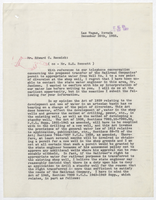
Letter from Calvin M. Cory (Las Vegas) to Edward C. Renwick, December 20, 1952
Date
Archival Collection
Description
Cory expresses the legal opinion that in an artesian basin, if you have a water right then the point of diversion makes no difference.
Text
