
Search Results

Christina Gruber oral history interview: transcript
Date
Archival Collection
Description
Oral history interview with Christina Gruber conducted by Barbara Tabach on March 2, 2019 for the Remembering 1 October Oral History Project. In this interview, Gruber shares her experience living in Las Vegas, Nevada since 1997 and as a Certified Public Accountant (CPA), mother of two, and physical fitness enthusiast. She recalls being shot during the Route 91 Harvest Festival and being rescued by strangers. She recalls the chaos of the evening, but also how strangers worked together to comfort each other amidst the terror. She discusses dedicated her athletic races to those who were murdered that evening, and how it has helped her recovery.
Text

Paul Velez oral history interview: transcript
Date
Archival Collection
Description
Oral history interview with Paul Velez conducted by Barbara Tabach on February 22, 2018 for the Remembering 1 October Oral History Project. In this interview, Paul Velez, a University of Nevada, Las Vegas (UNLV) campus officer, discusses his experience at the Thomas & Mack Center during the night of the October 1, 2017 mass shooting in Las Vegas, Nevada. He shares his goal of creating a safe atmosphere for the survivors and providing them with all of their needs, including helping separated survivors find their loved ones and friends. Velez also describes his move to Las Vegas in 2008 and his time with the New York City police force, talking about his experience as a first responder at Ground Zero during the 9/11 attacks. He discusses the effect these attacks have had on general and campus security measures and on him as an individual.
Text

Interview with George Robert Maynard, Sr., January 26, 2004
Date
Archival Collection
Description
Text

Interview with Theresa Dorothy (Healy) Maynard, January 26, 2004
Date
Archival Collection
Description
Text

Transcript of interview with Edwina E. Danzienger by Leanne Terry, February 26 & 29, 1980
Date
Archival Collection
Description
On February 26 and 29 of 1980, Leanne Terry interviewed Edwina E. Danzinger (born 1925 in Houston, Texas) about her life in Southern Nevada. Danzinger first talks about her family, specifically her siblings, children, and grandchildren. She also talks about church membership, early housing in Nevada, her husband’s work on the Nevada Test Site, and her family’s hunting practices. Danzinger then describes her involvement in Boy Scouts and hiking, her various positions of employment at the University of Nevada, Las Vegas, how the college campus has changed over time, and how the college students have changed over the years. The two also talk about the changes in the crime rate, the atomic testing, air pollution, and the changes made to the university by the Buckley Amendment.
Text

Transcript of interview with Eldon Cooper by Kamal Whilelm, March 3, 1975
Date
Archival Collection
Description
On March 3, 1975, Kamal Wilhelm interviewed Eldon G. Cooper (born 1922 in Overton, Nevada) about his experiences in Southern Nevada. Also present are Cooper’s wife and several unnamed adults in the background. Cooper first talks about his background and his eventual move to Las Vegas before describing the recreational activities in which he and his family took part. He later describes the atomic testing, environmental changes, modes of transportation, social changes, and tourism in Las Vegas. Cooper also discusses the Stewart Ranch, and his wife describes the setting of multiple photographs taken of properties in the Downtown Las Vegas area.
Text

Transcript of interview with Dr. Leonard Kreisler by Barbara Tabach, May 23, 2016
Date
Archival Collection
Description
Dr. Leonard Kreisler, MD, was born August 3, 1930 in Brooklyn to post World War I European Jewish immigrants. Raised in the smaller community of White Plains, New York, he worked happily by his father?s side. The elder Kreisler was a cabinet maker and carpenter, who Len describes as fiercely independent. Young Len keenly helped his Yiddish language father write his contracts and guided him to increasing his prices. At an early age, Len knew that he would become a medical doctor?little did he know what an amazing life was in his future. It was while attending the University of Vermont, College of Medicine that Len met his wife Joan. They married in June 1957. Joan became a teacher and later a real estate agent while in Las Vegas. This interview includes stories about his medical education and his thirteen year private medical practice in Peekskill, New York. This was followed by a career in occupational medicine and over seventeen years as the Medical Director at the Nevada Test Site for Reynolds Electric and Engineering Corporation (1973 ? 1990). During that time he was also elected Chief of Staff at University Medical Center (UMC) for two years and helped create the Children?s Miracle Network Telethon and the UMC Foundation. When he recalls moving to Las Vegas, his memories include jogging by Temple Beth Sholom and joining a minyan. He became a congregation vice president. When his career at the Test Site was halted, his medical adventure led him to be a maritime physician for a cruise liner. He also ran twice for Clark County Commissioner against Thalia Dondero. Dr. Kreisler is the author of several books: Death by Any Means (2005); Roll the Dice, Pick a Doc and Hope for the Best (2009); The Codes of Babylon (2010); Shortfall (2011); The Obligated Volunteer (2014) and In Bed Alone, A Caregiver?s Odyssey (2016).
Text
Transcript of interview with Stanley Weiner by Kyle Wolff, March 12, 1978
Date
Archival Collection
Description
Interview with Stanley Weiner by Kyle Wolff on March 12, 1978. In this interview, Weiner begins by talking about his father's employment, and then his own series of jobs, including as a department manager at Sears. He discusses living in different parts of town, population growth, educational opportunities, transportation, and recreation. The interviewer asks specific questions about sports, hotels, unions, and the weather.
Text

Transcript of interview with Audrey Wickman by Joanne Goodwin, June 24, 1996
Date
Archival Collection
Description
Born in the coal fields of Strunk, Kentucky, Audrey Aline Messer Wickman first visited the West at twelve years of age. She moved to western Colorado to help in her grandparents’ home for a couple of years. The stay made a lasting impression because she only returned to her birthplace for a short time after that. In Colorado, she graduated from high school, met her future husband, and married in 1925. They came to southern Nevada in 1932 so that Robert Wickman could find work on Hoover Dam. Audrey Wickman joined the Mesquite Club in 1936 and has remained a member to date. She started the Literary Committee as a forum to share book reviews and hear speakers. She served as President of the club for 1947-48 and chose the year’s theme “Know your Neighbor.” In the post-war society, women’s involvement in civic affairs was particularly needed, she told the membership at the opening fall meeting. “The troubles which unsettle the world today are primarily ones which lie within the sphere of women’s business. They are matters of housekeeping, teaching and health. . . . The time has come when we as a nation cannot stay in our own backyards. . . . If we are to be good world citizens, local, state and national, we must first be good home citizens. These responsibilities call for knowledge, an appreciation of other points of view, and attitudes of good will and cooperation.” (Las Vegas Review Journal, 6 October 1947, Mesquite Club microfilm collection.) The duties of the president varied during those years. She recalled that “I was janitor, gardener and President.” During the wintertime, she remembered, “you had to have heat [for Friday’s meeting] and I’d go up on Thursday afternoon and light that old oil burning stove and then pray that it didn’t catch the place on fire all night.” She continued her commitment to club work by serving as state secretary for the Nevada Federation of Women’s Clubs. The friendships and cultural events which came from Mesquite Club and Federation membership proved to be of lasting value for this community builder. This interview has been produced with the assistance of the Mesquite Club and the History Department of the University of Nevada, Las Vegas. It is part of a series on women community builders in Las Vegas. The transcript has been edited only slightly for clarity while the syntax and style of the narrator were retained.
Text
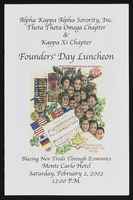
Alpha Kappa Alpha Sorority, Theta Theta Omega Chapter Founders' Day committee reports
Date
Archival Collection
Description
From the Alpha Kappa Alpha Sorority, Incorporated, Theta Theta Omega Chapter Records (MS-01014) -- Chapter records file.
Text