
Search Results

Audio recording clip of interview with Jean Bennett by Claytee D. White, July 8, 2008
Date
Archival Collection
Description
Part of an interview with Jean Bennett by Claytee White on July 8, 2008. Bennett describes how black entertainers were treated by the casinos.
Sound

Transcript of interview with Susan Fine by Cecillia Boland, February 18, 1976
Date
Archival Collection
Description
Interview with Susan Greenspun Fine by Cecillia Boland on February 18, 1976. In this interview, Fine talks about growing up in Las Vegas and her schooling. The interview is geared towards the growth of Las Vegas from her childhood to her adulthood, including roads, air travel and medical facilities. She is the daughter of Hank and Barbara Greenspun, owners of the Las Vegas Sun newspaper, and discusses being involved in all the happenings around town because of that.
Text
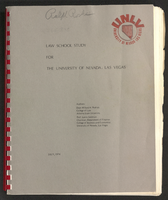
Law School Study for the University of Nevada, Las Vegas (final draft)
Date
Archival Collection
Description
A final draft version of the "Law School Study for the University of Nevada, Las Vegas" by Dean Willard H. Pedrick, College of Law, Arizona State University, and Professor Lorne Seidman, Chairman, Department of Finance, College of Business and Economics, University of Nevada, Las Vegas.. From the University of Nevada, Las Vegas William S. Boyd School of Law Records (UA-00048).
Text
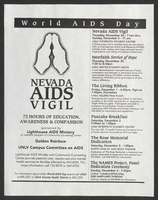
World AIDS day Nevada AIDS vigil flyer
Date
Archival Collection
Description
Text
Video Interview with Ruby Amie Pilot at Vegas PBS, April 12, 2013
Date
Archival Collection
Description
Ruby shares highlights of her life and career path such as working with Hazel Gay, and working as the first fulltime black employee at Sears, and at Palm Mortuary. She provides details of breaking the color barrier on the Strip in 1960s.
Moving Image
Video Interview with Eva G. Simmons at Vegas PBS, November 19, 2013
Date
Archival Collection
Description
Eva is a founder of Les Femme Douze, a teacher for nearly four decades, community leader. Talks about recruitment of black teachers; Mabel Hoggard among other topics from the 1960s-1980s; and the future of the Westside.
Moving Image
Video Interview with Sonny Thomas at Vegas PBS, April 1, 2013
Date
Archival Collection
Description
Sonny operates the Thomas & Jones Funeral Home. He recalls the funeral industry and his first jobs in casino kitchens from 1960 - 1980s.
Moving Image
Video Interview with Hannah Brown at Vegas PBS, April 2, 2013
Date
Archival Collection
Description
Hannah describes her love of education, being a woman of "firsts" and president of 100 Black Women. She recounts stories about growing up on the Westside and crossing paths with famous people.
Moving Image