
Search Results
David Rea Collection of Howard Hughes Publicity Photographs
Identifier
Abstract
This collection is comprised of publicity photographs of Howard Hughes and his aircrafts, from approximately the 1940s to the 1950s, that were compiled by David Rea, former pilot for Hughes Aircraft Company. This collection also includes clippings and technical drawings of Hughes aircrafts.
Archival Collection
Florence Lee Jones Cahlan Photographs
Identifier
Abstract
The Florence Lee Jones Cahlan Photographs depict locations and events in Las Vegas, Nevada from 1909 to 1980. The photographs primarily depict historical locations, including the Las Vegas Mormon Fort, the Kiel Ranch, and plaques commemorating Las Vegas’s 75th anniversary. The photographs also depict celebrations, including the Diamond Jubilee festivities held to celebrate Las Vegas’s 75th anniversary, plaque dedications, building dedications, and the 50th anniversary of the arrival of the first mail planes in Las Vegas. The photographs include the Kennecott Copper Corporation’s facilities in McGill, Nevada, Western Airlines planes and pilots, and Union Pacific Railroad locomotives.
Archival Collection
Donna Andress Papers
Identifier
Abstract
The Donna Andress Papers (1890-2024) contain the personal papers of Donna Andress, a longtime resident and activist in Southern Nevada. Materials include correspondence and newspaper clippings from the Nevada Welfare Committee, on which Andress served as chairperson during the 1970s, in addition to pamphlets and newsletters from various Nevada historical organizations and committees. The papers reflect her involvement with community organizations throughout Southern Nevada.
Archival Collection
Marjorie Barrick Museum of Natural History Records
Identifier
Abstract
The Marjorie Barrick Museum of Natural History Records (1939-2022) detail the creation of the Marjorie Barrick Museum of Natural History in Las Vegas, Nevada founded by Richard H. Brooks, a professor of anthropology at the University of Nevada, Las Vegas. The records are comprised primarily of correspondence between Brooks and members of the Southwestern Anthropological Association (SWAA), the Society for California Archaeology (SCA), and the meetings and exhibitions of the Nevada State Museum. The collection also contains financial statements that describe expenses for supplies, research, and excursions. Also included are anthropological, archaeological, and historical publications, as well as administrative files and Richard Brooks' correspondence with the Nevada Archaeological Survey (NAS). The collection also includes architectural floor plans for the Classroom and Physical Education, the original space that was converted into the museum in 1980, and plans for the redesign of the Barrick Museum and the Harry Reid Environmental Research Center addition.
Archival Collection
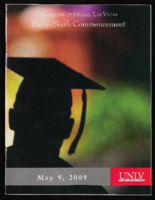
University of Nevada, Las Vegas (UNLV) 46th commencement program
Date
Archival Collection
Description
Commencement program from University of Nevada, Las Vegas Commencement Programs and Graduation Lists (UA-00115).
Text
Evelyn Garcia-Morales (Clark County School Trustee) oral history interview conducted by Magdalena Martinez: transcript
Date
Archival Collection
Description
From the Lincy Institute "Perspectives from the COVID-19 Pandemic" Oral History Project (MS-01178) -- Elected official interviews file.
Text
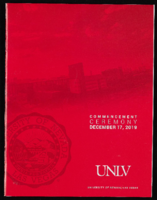
University of Nevada, Las Vegas (UNLV) Fall 2019 commencement program
Date
Archival Collection
Description
Commencement program from University of Nevada, Las Vegas Commencement Programs and Graduation Lists (UA-00115).
Text

Sandra Gray oral history interview: transcript
Date
Archival Collection
Description
Oral history interview with Sandra Gray conducted by Elsa Lopez and Barbara Tabach on December 13, 2019 for the Latinx Voices of Southern Nevada Oral History Project. In this interview, Dr. Gray discusses her family history, and describes how her parents are immigrants from Durango, Mexico and moved from East Los Angeles, California to East Las Vegas, Nevada in 1991. After getting her bachelor's degree in psychology from the University of Nevada, Las Vegas (UNLV) she started a behavioral health agency that provided rehabilitative mental health services to children primarily in the foster care system. She went on to earn a master's degree in mental health counseling, a master's in psychology, and a doctoral degree in clinical psychology. She is the founder of Empower LV, which strives for equitable access to sports and tutoring. Dr. Sandra Gray is also the owner and operator of Innovation Behavioral Health Solutions, LLC.
Text
Wolff, Walter P., 1928-2016
http://www.ladailypost.com/content/obituary-walter-p-wolff-dec-29-2016
copied from resouce above
Person
Regional subject files, 1859, 1908, 1970-2015
Level of Description
Scope and Contents
The regional subject files include materials collected by anthropologist Katherine Spilde about Native American gaming, Native American communities in the United States, and the US and international gaming industries. The materials date from 1859 to 2015, with the bulk of materials dating from 1990 to 2010. Materials dating from the nineteenth and early twentieth centuries are a reproduction of a federal treaty and an ethnohistorical essay. The majority of the materials document Native American gaming following the passage of the 1988 Indian Gaming Regulatory Act. The papers include research and subject files created by Dr. Spilde during her employment with the National Gambling Impact Study Commission (NGISC), National Indian Gaming Association (NIGA), and Harvard Project on American Indian Economic Development (HPAIED). The materials document Native American gaming enterprises both on and off reservations, the socioeconomic impact of gaming, the political history of gaming in the US, and international gaming. The series includes socioeconomic reports, testimonies, correspondence, memos, press releases, photographs, audiovisual materials, promotional materials, brochures, fact sheets, summaries, booklets, pamphlets, advertisements, tourism materials, journal articles, legal briefs, legislative documents, court opinions, notes, presentations, conference materials, periodicals, community newspapers, and newspaper articles.
The collection contains documentation on a number of Native American nations, including the Misi-zaaga'iganiing Anishinaabeg (Minnesota Chippewa Tribe, Mille Lacs Band); Gaa-waabaabiganikaag Anishinaabeg (Minnesota Chippewa Tribe, White Earth Band); Forest County Bodéwadmi (Forest County Potawatomi Community); Ho-Chunk Nation of Wisconsin; Mashantucket Pequot Indian Tribe; Mohegan Tribe of Indians; Tulalip Tribes of Washington; Sisseton-Wahpeton Oyate of the Lake Traverse Reservation; Standing Rock Sioux Tribe of North and South Dakota; Mandan, Hidatsa, and Sahnish (Arikara) (Three Affiliated Tribes of the Fort Berthold Reservation, North Dakota); and Mississippi Band of Choctaw Indians. Other communities are also represented in the series, but to a lesser extent. In addition to materials about gaming and casinos, Dr. Spilde also collected documents, photographs, and audiovisual materials about Native American culture in general. The series documents regional and national trends in Native American gaming, and the greater gaming industry. Materials trace federal and state relationships with individual Native American nations, specifically concerning gaming enterprises.
Archival Collection
Archival Component