Search Results

Transcript of interview with Billy Paul Smith by Claytee White, October 3, 2013
Date
Archival Collection
Description
Chemist, mathematician, and health physicist Billy Paul Smith donates time to tutor young people in hopes of attracting more youth into the fields of math and science. Born in 1942 and schooled in segregated black schools in Shreveport, Louisiana, and Texarkana, Texas, he graduated from high school at age fifteen and enrolled at Prairie View A&M University, where he trained with the Reserve Officer Training Corps (ROTC) and earned his Bachelor’s degree in chemistry and in 1964 his Master’s degrees in chemistry and math. Most young U.S. Army officers in 1964 went to Vietnam, but Billy’s math and science background steered him to the Army Chemical Corps, where he was quickly selected to join a new team. The team was to develop responses to nuclear weapon accidents and worked under the Defense Atomic Support Agency (DASA) in Albuquerque, New Mexico. At the same time, Billy completed the Weapons Ordinance Army course on classified information relating to the U.S. nuclear weapons arsenal. In this interview, Billy talks about his service with DASA and his subsequent twenty-seven years working at the Nevada Test Site in a variety of positions with Reynolds Electrical and Engineering Company, Inc. (REECo), a company that had “percentagewise more blacks in management positions than any other [Las Vegas] company.” He experienced the quiet racism of Las Vegas residential segregation when he tried to purchase a house in a neighborhood he liked and the unexpected kindness of the REECo general manager, Ron Keen, who made sure the Smith family could live where they wanted to live. He talks about Area 51 and explains underground testing activity and offers the scientific and ecological reasons why scientists deemed Yucca Mountain safe to store nuclear waste. After retiring at fifty-two, Billy and a colleague formed an independent instrumentation company, which, from 1995–2005 provided and calibrated radiological measurement and detection instruments for the decommissioning and closure of the Rocky Flats nuclear plant in Golden, Colorado. During that time, Billy rented an apartment in Boulder, but he and Jackie maintained their Las Vegas home, where they still reside. Billy shares memories of places he and his wife used to enjoy on the Westside and tells of their longtime friends in the black community. He also talks about developing his philosophy of philanthropy through Alpha Phi Alpha Fraternity and discusses becoming a member of the Knowledge Fund Advisory Council for the Governor’s Office of Economic Development (GOED) and the advisory council for the Nevada System of Higher Education.
Text

Greg Phelps oral history interview: transcript
Date
Archival Collection
Description
Oral history interview with Greg Phelps conducted by Claytee D. White on November 15, 2017 for the Remembering 1 October Oral History Project. Greg Phelps discusses moving to Las Vegas, Nevada in 2002 for work and attending the 2017 Route 91 Harvest festival with his mother and wife. He describes the event venue as well as his recollection of the shooting. Phelps explains how his life changed after that day, describing the true friendships he gained and his greater appreciation for living.
Text
Economic Opportunity Board of Clark County (Nev.) monthly reports
Date
Archival Collection
Description
From the Clark County Economic Opportunity Board Records -- Series I. Administrative. This folder contains monthly reports from various program coordinators to the Economic Opportunity Board of Clark County, Nevada from 1971 through 1973
Text

Micheal Miller interview, April 5, 1976: transcript
Date
Archival Collection
Description
On April 5, 1976, collector Broderick T. Ackerman interviewed Michael Miller who has lived in Nevada since 1910. In this interview, Mister Miller speaks about his time working on ranches and as a trapper in Northern Nevada. He also speaks about his time running nightclubs in Las Vegas, Nevada, as well as seeing much growth throughout his time living in Las Vegas.
Text
Meeting minutes for Consolidated Student Senate University of Nevada, Las Vegas, March 10, 1988
Date
Archival Collection
Description
Text
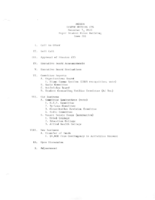
Meeting minutes for Consolidated Student Senate, University of Nevada, Las Vegas, December 05, 1978
Date
Archival Collection
Description
Text

Transcript of interview with Freddie Glusman by Barbara Tabach, October 29, 2015
Date
Archival Collection
Description
In this interview Glusman discusses his early memories of being raised in Vancouver, Canada and how he ended up in Las Vegas. He reflects on how he first got his start in the town and his early dealings with casinos and their owners while he was working as a carpet and drapery salesman and while working for Fabulous Magazine. Glusman explains how he started his restaurant and tells about the people he encountered while doing this that where significant to both the Jewish community and Las Vegas as a whole. He recounts stories that include such people as Meyer Lansky, Al Sachs, and Moe Dalitz.
Text