
Search Results

Transcript of interview with Fluff LeCoque by Joyce Marshall, May 5, 1997
Date
Archival Collection
Description
This interview is compiled in the bound book version for OH-02270. Born Ffolliott Chorlton in Butte, Montana in 1923, Fluff Le Coque embarked on a career during World War II that would span fifty-five years. Le Coque’s experience as an entertainer started at the age of seven when she began dance lessons during the Great Depression. She expanded her interest in show business at the University of Washington. Attending on a drama scholarship, she performed in theatrical productions and supplemented the scholarship by teaching coordination to university athletes through dance. Le Coque toured as a dancer in a road company during World War II. After the war she came to Las Vegas for the first time. Although she did not consider herself a singer, she performed as a vocalist with the Chuck Gould Orchestra at the Last Frontier. After a brief excursion to Hollywood, she returned to Las Vegas to work at the Thunderbird Hotel as a dancer. It was at the Thunderbird that she became part of the glamour publicity that would help shape the image of Las Vegas. Crowned “Miss Thunderbird,” Le Coque took part in publicity photo shoots designed to attract vacationing customers to the Las Vegas resort casino. While performing at the Thunderbird, Le Coque learned of an opportunity to showcase her talents in a wider arena. She joined a touring company that was preparing to take the production of Hollywood Extravangza to Europe. In Paris, Le Coque took on additional responsibilities in the production end of the business. She served the Hollywood Extravaganza as principal dancer, choreographer, and ballet mistress. On her return to New York, she firmed up her career-long relationship with producers Donn Arden and Ron Fletcher. Le Coque’s association with Arden-Fletcher Productions proved beneficial for an already successful career. She performed as principal dancer for Arden and Fletcher beginning with a six-month engagement at the Lookout House in Cincinnati, Ohio, in the late 1950s Arden wanted her to return to Las Vegas and she accepted immediately. The Las Vegas Desert Inn opened a newly remodeled showroom with Fluff Le Coque as a featured principal dancer. Arden-Fletcher Productions kept a number of performers busy throughout the United States from California to New York. Le Coque, now a valued talent, appeared in the Arden-Fletcher production at the Moulin Rouge in Hollywood. She worked there as company captain and principal dancer for ten years. Following her extended engagement at the Moulin Rouge, she toured the United States and Europe before returning to Las Vegas for good in the late 1960s. Arden again asked her to open a renovated showroom at the Desert Inn and again she agreed. This time Le Coque made Las Vegas her permanent home. She danced until she was forty-five years old and during the later years worked both sides of the stage, as company manager and dancer. Fluff Le Coque retired from dancing in 1970 to enjoy leisure activities and volunteer work. She learned to paint and served as publicity director of the Las Vegas Art Museum. She was wooed out of retirement by Donn Arden, to become company manager of the production show at the new MGM Grand Hotel [later reopened as Bally’s]. At the time of the interview, Le Coque continued to serve as company manager for Jubilee at Bally’s Hotel & Casino. Le Coque’s narrative provides a vivid account of the history of the Las Vegas entertainment industry. In addition to the organization of club circuits during the post-war years, the narrative provides clues about white-black relations during the era. It also informs a wider historical context. Post-war American society underwent significant changes economically, politically, and socially. Expanded work opportunities for women were among those changes. Le Coque’s choice to complete a college education during the 1940s was atypical. Her successful dancing career and later move into production management provides an example of career achievement decades ealier than the majority of American women. By extending her career as a dancer into her forty-fifth year, she resisted the evolving publicity hype that only an ingenue could be a dancer. Her narrative provides a compelling description of both the glamour and physical demands associated with the Las Vegas entertainment industry.
Text
Syphus-Bunker Papers
Identifier
Abstract
The Syphus-Bunker Papers date from 1891 to 1994, with the majority of the collection consisting of correspondence between Mary Etta Syphus and John Mathieson Bunker from 1891 to 1895. The collection also contains correspondence from friends and relatives, and documentation related to Mary Etta Syphus' attendance at Brigham Young Academy Church Normal Training School. Other materials include family history information and two color photographs of family homes. The collection also includes typed transcripts of the correspondence.
Archival Collection

Film transparency of people at an observation point for Hoover Dam, September 19, 1931
Date
Archival Collection
Description
Image
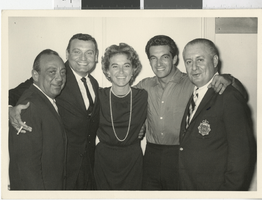
Photograph of Howie Engler, Harold Minsky, and others, Las Vegas (Nev.), 1970-1979
Date
Archival Collection
Description
Image

Photograph of YESCO workers installing Vegas Vic at the Pioneer Club (Las Vegas), 1951
Date
Archival Collection
Description
Workers installing the now-famous Vegas Vic sign on the front of the Pioneer Club. Stamped on back of photo: "Photo by Desert Sea News Bureau. Las Vegas, Nevada." Transcribed from photo sleeve: "First Highrise Hotel -- Center of action downtown throughtout the '30s was the Apache Hotel which boasted an elevator and a nitery downstairs. The corner is now Binion's Horseshoe, but the spot has undergone many name changes from Tony Cornero's 'S.S. Rex' to the Eldorado where the mobs were fighting for control of the race wire. Bugsy Siegel's influence was first felt here in the early '40s."
Site Name: Pioneer Club
Address: 25 East Fremont Street
Image
Shelley Berkley Papers
Identifier
Abstract
The Shelley Berkley Papers (1987-2012) consist primarily of correspondence and other documents pertaining to Shelley Berkley's tenure as United States Representative for Nevada 1st congressional district. Topics include nuclear waste storage at Yucca Mountain, education, women's rights, health care, foreign affairs, veterans, economics, and homeland security. The collection also includes photographs, interviews, and awards. Shelley Berkley served as a member of Congress between 1999 and 2013.
Archival Collection
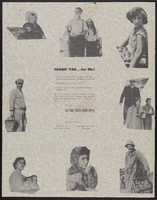
Las Vegas United Jewish Appeal "Thank You... for life!" poster, 1953-1959
Date
Archival Collection
Description
Thank You... for life! poster from the Las Vegas United Jewish Appeal asking for contributions to aid Jewish refugees. The text across the front reads: "THANK YOU... for life! -For a second chance to breathe as free human beings again... for the chance to toil and work with dignity and self-respect. -For the greatest give man can give - LIFE! -For this - we give you the greatest gift man can receive - GRATITUDE! Your contribution thru the Las Vegas Jewish Appeal has helped nearly 100 of 80,000 emergency rescue cases reach Israel from Poland and Moslem countries - for their second chance at life! Thank you. Las Vegas United Jewish Appeal. Carl Cohen, Chairman; Moe Dalitz and Jacob Kozloff, Co-chairmen; Edward Levinson, Nevada State Chairman"
Mixed Content

Transcript of interview with Julie Menard by Joyce Marshall, March 17, 1996
Date
Archival Collection
Description
Julie Menard began her career as a showgirl in 1964, performing in the Folies Bergere at the Tropicana Hotel. Although she appeared in the show for only sixteen months, she offers an insider’s view of the early Las Vegas entertainment scene. She describes a period when showgirls were treated as local royalty and “the boys” wielded considerable influence. Menard’s narrative sheds light on the glamour and complexities of the showgirl. Her descriptions of physical characteristics of the job, the day to day work schedules, the expectations of physical beauty, as well as the stigma of her occupation outside of Las Vegas offer a fuller view of the job. Menard left Las Vegas in 1966 to pursue a film career in Europe but like many Las Vegas entertainers, she returned to make the desert city her home. Although her brief performing career failed to prepare her for future employment, she relishes her brief experience as a showgirl. Her narrative evokes the glamour, excitement and mystery of Las
Text

Transcript of interview with Betty Bunch by Joyce Marshall, January 9, 1996, February 7, 1996, & February 13, 2002
Date
Archival Collection
Description
Betty [Rosenthal] Bunch began dancing as a child. By the time she was nine years old she decided she would have a dancing career. At 18 years she began to work in stock theatre productions. Within a short time, she had joined the Moro-Landis dancers. She landed her first job in Las Vegas in 1956 at the Sahara Hotel as part of the opening line for Donald O'Connor. Following the Sahara, she worked as a dancer at the Riveria, and then returned to the Moulin Rouge in Hollywood. In 1961 while vacationing in Las Vegas, she landed a job dancing at the Dunes. She continued to dance, sing and do comedy until after the birth of her second child. At that time, she retired from the Las Vegas showroom, but not from show business. Her involvement in both film and stage has remained rich and varied. This interview focuses on the time Betty spent performing on the Las Vegas strip, including her long involvement with the acclaimed afternoon show Bottoms Up. The interview provides information on workin
Text
Estelle Elliott and Julia Elliott oral history interview
Identifier
Abstract
Oral history interview with Estelle Eliott and Julia Elliott conducted by Vanessa Concepcion and Stefani Evans on December 2, 2021 for Reflections: The Las Vegas Asian American and Pacific Islander Oral History Project. Twins Estrellita "Estelle" and Julieta "Julia" Elliott share their personal histories growing up in Cebu City, Philippines with their grandparents. They discuss moving to the United States to live with their parents after the death of their grandfather, and how they preserved their "tricultural" Castilian Spanish, Filipino, and American identities. After graduating from Stevens College, an art and academic school in Missouri, Estelle recounts marrying her husband and moving to Las Vegas where she gave birth to her daughter. Julia shares how she followed Estelle a few years later to Las Vegas, and the two women share their experiences as entertainers on the Las Vegas Strip. Both Estelle and Julia joined Minsky's Burlesque before becoming a permanent act in Siegfried and Roy's show at the Frontier Hotel. They also discuss their performances with Kirby VanBurch at the Aladdin's Abracadabra Show, dancing at the Playboy Mansion, and how Siegfried and Roy helped to diversify Las Vegas entertainment by incorporating dancers and performers of color, like the King Charles Troupe, into their shows.
Archival Collection