
Search Results

Transcript of interview with Julie Menard by Joyce Marshall, March 17, 1996
Date
Archival Collection
Description
Julie Menard began her career as a showgirl in 1964, performing in the Folies Bergere at the Tropicana Hotel. Although she appeared in the show for only sixteen months, she offers an insider’s view of the early Las Vegas entertainment scene. She describes a period when showgirls were treated as local royalty and “the boys” wielded considerable influence. Menard’s narrative sheds light on the glamour and complexities of the showgirl. Her descriptions of physical characteristics of the job, the day to day work schedules, the expectations of physical beauty, as well as the stigma of her occupation outside of Las Vegas offer a fuller view of the job. Menard left Las Vegas in 1966 to pursue a film career in Europe but like many Las Vegas entertainers, she returned to make the desert city her home. Although her brief performing career failed to prepare her for future employment, she relishes her brief experience as a showgirl. Her narrative evokes the glamour, excitement and mystery of Las
Text

Transcript of interview with Jillian Hrushowy by Joyce Marshall, September 26, 1995
Date
Archival Collection
Description
Jillian Hrushowy arrived in Las Vegas in 1959 as part of a company hired to appear at the El Rancho Vegas Hotel in a production called La Nouvelle Eve. She has remained here (other than three short-term contracts in Reno, Nevada) until present day. She is now the production manager for Legends in Concert at the Imperial Palace Hotel. She was an only child, born in Rhodesia to English parents and raised in a home with servants and tutors. Her mother exposed her to the arts at an early age. Jillian took dancing lessons from the age of three years until she began dancing professionally. When she was fifteen years old, both parents agreed it was time for her to leave Rhodesia and finish her education in England. Living alone was difficult and lonely, but it afforded her a wealth of opportunities otherwise unavailable. She worked as a dancer in small, local productions while still in high school. When only eighteen, she got a job dancing in La Nouvelle Eve in Paris which eventually came to Las Vegas. This interview focuses on the years from Jillian’s arrival in 1959 until she retired from dancing in 1979. It follows her transitions from dancer, to principal dancer to production manager. [The first twenty minutes of the tape is warped and the text is garbled. The transcriber has lightly edited the transcript.]
Text

Transcript of interview with Kim Krantz by Joyce Marshall, February 26, 1996
Date
Archival Collection
Description
Kim Krantz arrived in Las Vegas in 1953. She came as a seasoned performer having danced in large productions in Chicago, Montreal, New York and Florida. Born Delores Kalcowski in Jersey City, New Jersey, she adopted the name Kim Perrin while working at New York’s Latin Quarter. She had always loved the West and jumped at the chance to take the Latin Quarter show from New York City to Las Vegas. She came for a two-week engagement at the Desert Inn Hotel. The show was held over at that property for three months, and then it moved to the Riviera Hotel and Casino. Bill Miller approached her to join a new production at the Dunes Hotel. He and Harold Minsky were preparing “Minsky’s Burlesque,” the first show to use women born in the United States in a nude show. She opened with the original cast and stayed for two years. Kim retired in 1957 after she married Danny Krantz, the Food and Beverage Manager for the Flamingo Hotel. She raised four children in Las Vegas, but never lost touch with th
Text

Transcript of interview with Betty Bunch by Joyce Marshall, January 9, 1996, February 7, 1996, & February 13, 2002
Date
Archival Collection
Description
Betty [Rosenthal] Bunch began dancing as a child. By the time she was nine years old she decided she would have a dancing career. At 18 years she began to work in stock theatre productions. Within a short time, she had joined the Moro-Landis dancers. She landed her first job in Las Vegas in 1956 at the Sahara Hotel as part of the opening line for Donald O'Connor. Following the Sahara, she worked as a dancer at the Riveria, and then returned to the Moulin Rouge in Hollywood. In 1961 while vacationing in Las Vegas, she landed a job dancing at the Dunes. She continued to dance, sing and do comedy until after the birth of her second child. At that time, she retired from the Las Vegas showroom, but not from show business. Her involvement in both film and stage has remained rich and varied. This interview focuses on the time Betty spent performing on the Las Vegas strip, including her long involvement with the acclaimed afternoon show Bottoms Up. The interview provides information on workin
Text

Transcript of interview with Fluff LeCoque by Joyce Marshall, May 5, 1997
Date
Archival Collection
Description
This interview is compiled in the bound book version for OH-02270. Born Ffolliott Chorlton in Butte, Montana in 1923, Fluff Le Coque embarked on a career during World War II that would span fifty-five years. Le Coque’s experience as an entertainer started at the age of seven when she began dance lessons during the Great Depression. She expanded her interest in show business at the University of Washington. Attending on a drama scholarship, she performed in theatrical productions and supplemented the scholarship by teaching coordination to university athletes through dance. Le Coque toured as a dancer in a road company during World War II. After the war she came to Las Vegas for the first time. Although she did not consider herself a singer, she performed as a vocalist with the Chuck Gould Orchestra at the Last Frontier. After a brief excursion to Hollywood, she returned to Las Vegas to work at the Thunderbird Hotel as a dancer. It was at the Thunderbird that she became part of the glamour publicity that would help shape the image of Las Vegas. Crowned “Miss Thunderbird,” Le Coque took part in publicity photo shoots designed to attract vacationing customers to the Las Vegas resort casino. While performing at the Thunderbird, Le Coque learned of an opportunity to showcase her talents in a wider arena. She joined a touring company that was preparing to take the production of Hollywood Extravangza to Europe. In Paris, Le Coque took on additional responsibilities in the production end of the business. She served the Hollywood Extravaganza as principal dancer, choreographer, and ballet mistress. On her return to New York, she firmed up her career-long relationship with producers Donn Arden and Ron Fletcher. Le Coque’s association with Arden-Fletcher Productions proved beneficial for an already successful career. She performed as principal dancer for Arden and Fletcher beginning with a six-month engagement at the Lookout House in Cincinnati, Ohio, in the late 1950s Arden wanted her to return to Las Vegas and she accepted immediately. The Las Vegas Desert Inn opened a newly remodeled showroom with Fluff Le Coque as a featured principal dancer. Arden-Fletcher Productions kept a number of performers busy throughout the United States from California to New York. Le Coque, now a valued talent, appeared in the Arden-Fletcher production at the Moulin Rouge in Hollywood. She worked there as company captain and principal dancer for ten years. Following her extended engagement at the Moulin Rouge, she toured the United States and Europe before returning to Las Vegas for good in the late 1960s. Arden again asked her to open a renovated showroom at the Desert Inn and again she agreed. This time Le Coque made Las Vegas her permanent home. She danced until she was forty-five years old and during the later years worked both sides of the stage, as company manager and dancer. Fluff Le Coque retired from dancing in 1970 to enjoy leisure activities and volunteer work. She learned to paint and served as publicity director of the Las Vegas Art Museum. She was wooed out of retirement by Donn Arden, to become company manager of the production show at the new MGM Grand Hotel [later reopened as Bally’s]. At the time of the interview, Le Coque continued to serve as company manager for Jubilee at Bally’s Hotel & Casino. Le Coque’s narrative provides a vivid account of the history of the Las Vegas entertainment industry. In addition to the organization of club circuits during the post-war years, the narrative provides clues about white-black relations during the era. It also informs a wider historical context. Post-war American society underwent significant changes economically, politically, and socially. Expanded work opportunities for women were among those changes. Le Coque’s choice to complete a college education during the 1940s was atypical. Her successful dancing career and later move into production management provides an example of career achievement decades ealier than the majority of American women. By extending her career as a dancer into her forty-fifth year, she resisted the evolving publicity hype that only an ingenue could be a dancer. Her narrative provides a compelling description of both the glamour and physical demands associated with the Las Vegas entertainment industry.
Text
Transcript of interview with Gail S. McQuary by Joanne L. Goodwin, April 14, 1997, May 25, 1997, & May 28, 1997
Date
Archival Collection
Description
Interviewed by Joanne L. Goodwin. Gail Spaulding (Jaros) was born on October 16, 1937, in Cicero, Illinois. a suburb of Chicago. Both of her parents were in show business. Gail began tap and ballet lessons when she was five years old. She signed as a dancer with Moro-Landis Productions in 1956, and she worked for that company at the Sahara Hotel and Casino in Las Vegas, the Riverside Hotel and Casino in Reno, and the Beverly Hills Country Club in Covington, Kentucky. Gail was promoted to line captain and did choreography at the Beverly Hills Country Club. She stopped dancing shortly before her daughter was born and worked as a cocktail waitress at the Riverside Hotel and Casino and at the Mapes Hotel in Reno. In 1964 she moved back to Las Vegas, trained in real estate, became general sales manager and corporate broker for Realty Executives in Las Vegas and later worked as an associate with Dyson and Dyson Real Estate in Indian Wells, California.
Text
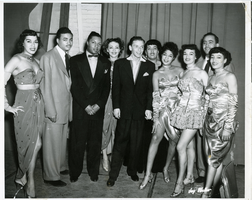
Group photograph of entertainers at the Dunes, including Anna Bailey and Frank Sinatra
Date
Archival Collection
Description
Black and white group photograph by Jay Walker of Anna Bailey with other entertainers, including Frank Sinatra, at the Dunes Hotel and Casino.
Image