
Search Results

Jill Roberts oral history interview: transcript
Date
Archival Collection
Description
Oral history interview with Jill Roberts conducted by Barbara Tabach and Claytee D. White on March 20, 2018 for the Remembering 1 October Oral History Project. In this interview, Jill Roberts discusses her position as the CEO of the Trauma Intervention Program (TIP) of Southern Nevada. She also delves into her part-time work at the coroner's office as a death investigator and discusses her personal background in Las Vegas, Nevada after she moved to the city in 1977. She describes the role TIP had during the aftermath of the October 1, 2017 mass shooting, where well-trained volunteers were dispatched to hotels, hospitals, and anywhere else the survivors reached in order to provide emotional and practical support. Throughout the interview, Roberts emphasizes that the assistance provided to those in a traumatic event depends on each individual's needs. She shares a few examples of what the TIP volunteers had helped with after the shooting, including listening to the survivors' stories as well as providing information on the situation, helping separated loved ones find each other, arranging travel for some survivors to go back to their homes, and procuring clothes and shoes for those who needed them. Roberts also discusses the gratitude TIP had received after the shooting, including the thank you cards sent by Sandy Hook High School.
Text

Paul Velez oral history interview: transcript
Date
Archival Collection
Description
Oral history interview with Paul Velez conducted by Barbara Tabach on February 22, 2018 for the Remembering 1 October Oral History Project. In this interview, Paul Velez, a University of Nevada, Las Vegas (UNLV) campus officer, discusses his experience at the Thomas & Mack Center during the night of the October 1, 2017 mass shooting in Las Vegas, Nevada. He shares his goal of creating a safe atmosphere for the survivors and providing them with all of their needs, including helping separated survivors find their loved ones and friends. Velez also describes his move to Las Vegas in 2008 and his time with the New York City police force, talking about his experience as a first responder at Ground Zero during the 9/11 attacks. He discusses the effect these attacks have had on general and campus security measures and on him as an individual.
Text
Transcript of interview with Stan Irwin by Cork Proctor, October 24, 2003
Date
Archival Collection
Description
Stan Irwin shares details of his background, family, and early show business experiences. His life story spans many decades and includes attending NYU, doing stand-up comedy, flying during WWII, working at Club Bingo in Las Vegas, and building up the entertainment at the Sahara Hotel. Mr. Irwin comments on many aspects of the Las Vegas entertainment scene. He recalls many headliners that he worked with and shares anecdotes about several. The Beatles, Johnny Carson, Dinah Washington, Billie Holliday, Lena Home, and Pearl Bailey are just a few of the many outstanding performers that he brought to Las Vegas. Stan offers comments on racism in Las Vegas thirty and forty years ago, and gives his opinions on the Mob, Howard Hughes, prostitution, and dress codes in the fifties and sixties, among other things. He recalls how Las Vegas looked in the early days, mentions a cardiovascular health project for children that he's involved with today, and gives a little insight into staying fit at eighty-plus.
Text

Transcript of interview with Eldon Cooper by Kamal Whilelm, March 3, 1975
Date
Archival Collection
Description
On March 3, 1975, Kamal Wilhelm interviewed Eldon G. Cooper (born 1922 in Overton, Nevada) about his experiences in Southern Nevada. Also present are Cooper’s wife and several unnamed adults in the background. Cooper first talks about his background and his eventual move to Las Vegas before describing the recreational activities in which he and his family took part. He later describes the atomic testing, environmental changes, modes of transportation, social changes, and tourism in Las Vegas. Cooper also discusses the Stewart Ranch, and his wife describes the setting of multiple photographs taken of properties in the Downtown Las Vegas area.
Text

Transcript of interview with Dr. Leonard Kreisler by Barbara Tabach, May 23, 2016
Date
Archival Collection
Description
Dr. Leonard Kreisler, MD, was born August 3, 1930 in Brooklyn to post World War I European Jewish immigrants. Raised in the smaller community of White Plains, New York, he worked happily by his father?s side. The elder Kreisler was a cabinet maker and carpenter, who Len describes as fiercely independent. Young Len keenly helped his Yiddish language father write his contracts and guided him to increasing his prices. At an early age, Len knew that he would become a medical doctor?little did he know what an amazing life was in his future. It was while attending the University of Vermont, College of Medicine that Len met his wife Joan. They married in June 1957. Joan became a teacher and later a real estate agent while in Las Vegas. This interview includes stories about his medical education and his thirteen year private medical practice in Peekskill, New York. This was followed by a career in occupational medicine and over seventeen years as the Medical Director at the Nevada Test Site for Reynolds Electric and Engineering Corporation (1973 ? 1990). During that time he was also elected Chief of Staff at University Medical Center (UMC) for two years and helped create the Children?s Miracle Network Telethon and the UMC Foundation. When he recalls moving to Las Vegas, his memories include jogging by Temple Beth Sholom and joining a minyan. He became a congregation vice president. When his career at the Test Site was halted, his medical adventure led him to be a maritime physician for a cruise liner. He also ran twice for Clark County Commissioner against Thalia Dondero. Dr. Kreisler is the author of several books: Death by Any Means (2005); Roll the Dice, Pick a Doc and Hope for the Best (2009); The Codes of Babylon (2010); Shortfall (2011); The Obligated Volunteer (2014) and In Bed Alone, A Caregiver?s Odyssey (2016).
Text

Transcript of interview with Stanley Weiner by Kyle Wolff, March 12, 1978
Date
Archival Collection
Description
Interview with Stanley Weiner by Kyle Wolff on March 12, 1978. In this interview, Weiner begins by talking about his father's employment, and then his own series of jobs, including as a department manager at Sears. He discusses living in different parts of town, population growth, educational opportunities, transportation, and recreation. The interviewer asks specific questions about sports, hotels, unions, and the weather.
Text

Transcript of interview with Audrey Wickman by Joanne Goodwin, June 24, 1996
Date
Archival Collection
Description
Born in the coal fields of Strunk, Kentucky, Audrey Aline Messer Wickman first visited the West at twelve years of age. She moved to western Colorado to help in her grandparents’ home for a couple of years. The stay made a lasting impression because she only returned to her birthplace for a short time after that. In Colorado, she graduated from high school, met her future husband, and married in 1925. They came to southern Nevada in 1932 so that Robert Wickman could find work on Hoover Dam. Audrey Wickman joined the Mesquite Club in 1936 and has remained a member to date. She started the Literary Committee as a forum to share book reviews and hear speakers. She served as President of the club for 1947-48 and chose the year’s theme “Know your Neighbor.” In the post-war society, women’s involvement in civic affairs was particularly needed, she told the membership at the opening fall meeting. “The troubles which unsettle the world today are primarily ones which lie within the sphere of women’s business. They are matters of housekeeping, teaching and health. . . . The time has come when we as a nation cannot stay in our own backyards. . . . If we are to be good world citizens, local, state and national, we must first be good home citizens. These responsibilities call for knowledge, an appreciation of other points of view, and attitudes of good will and cooperation.” (Las Vegas Review Journal, 6 October 1947, Mesquite Club microfilm collection.) The duties of the president varied during those years. She recalled that “I was janitor, gardener and President.” During the wintertime, she remembered, “you had to have heat [for Friday’s meeting] and I’d go up on Thursday afternoon and light that old oil burning stove and then pray that it didn’t catch the place on fire all night.” She continued her commitment to club work by serving as state secretary for the Nevada Federation of Women’s Clubs. The friendships and cultural events which came from Mesquite Club and Federation membership proved to be of lasting value for this community builder. This interview has been produced with the assistance of the Mesquite Club and the History Department of the University of Nevada, Las Vegas. It is part of a series on women community builders in Las Vegas. The transcript has been edited only slightly for clarity while the syntax and style of the narrator were retained.
Text

Herman Jimerson, Ruth Jimerson-Carter, and Leon Carter Jr. oral history interview: transcript
Date
Archival Collection
Description
Herman Jimerson and his younger sister Ruth Jimerson-Carter, along with her husband Leon Carter Jr., gathered on March 3, 2021, to talk about their memories and experiences growing up in West Las Vegas—the Westside.
OH-03746 contains additional interviews with the Carter family that are not transcribed in this document. Contact special.collections@unlv.edu for more information.
Text
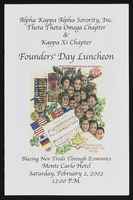
Alpha Kappa Alpha Sorority, Theta Theta Omega Chapter Founders' Day committee reports
Date
Archival Collection
Description
From the Alpha Kappa Alpha Sorority, Incorporated, Theta Theta Omega Chapter Records (MS-01014) -- Chapter records file.
Text

Transcript of interview with Elizabeth "Betty" Krolak by Irene Rostine, September 26, 1995
Date
Archival Collection
Description
In 1962, Elizabeth “Betty” Krolak moved from the Midwest to Las Vegas with her husband and six children. Not only would the drier desert climate benefit her youngest daughter’s health due to asthma, but the family hoped the Las Vegas economy would be beneficial for their future. Prior to her arrival in Las Vegas, Betty worked briefly as a secretary for the New York Central Railroad before becoming a stay-at-home mom and active member of the PTA. Upon their arrival in Las Vegas, Betty’s husband enrolled in a real estate class, but was unable to complete the program. Betty, not wanting to waste the $80 they had spent on the class, decided to attend in his place. This decision led to life changing events for Betty and her family over the next four decades. After taking the real estate class and passing the test, Betty became a licensed Nevada real estate broker in October of 1963. She initially went to work for Pyramid Realty and, in 1964, she opened her own office, Clark County Realty. After her divorce in 1967, Betty was left with “six hungry children” to feed and no child support or health insurance. She recalls how the benefits of being in real estate really became apparent during this period of her life. While real estate required long hours seven days a week, it also afforded a single mother flexibility that other careers would not have offered. Likewise, a woman could make more money in real estate in the 1960s and 1970s than most other careers provided, which was particularly important for Betty who was committed to raising her children without public assistance. Betty’s oral history chronicles the growth of the Las Vegas Board of Realtors which has grown into what today is the Greater Las Vegas Association of Realtors (GLVAR). She recalls how, in the 1960s, meetings took place in bowling allies and the primary role of the GLVAR was to provide networking opportunities and represent the Code of Ethics for realtors. However, the Board was dominated by males, with the role of women members confined to planning social events and arranging for refreshments. In 1968, Betty and several other women realtors set out to change this by initially establishing a local Women’s Council within the Board. In the years following, Betty became the first women to be an Executive Board Member. Today, more than half the members of the Executive Board are women. Betty’s oral history also speaks to many changes within the real estate industry over the past four decades, some positive and some not so positive. She recounts the 1960s to the 1980s, when casino workers’ main source of income came from tips which were often unreported, creating challenges in getting casino workers qualified for home loans because they did not have the ability to document their source of income. Likewise, single women had a hard time qualifying for home loans because they only had one income and, in those days, it rarely was enough to qualify for a mortgage on their own. Also during this period, realtors primarily focused on the resale market because builders wanted to work directly with buyers, but changes in the real estate market eventually led builders to realize the benefits of allowing realtors to sell new houses, too. During her career, Betty also experienced the rise of real estate franchises, beginning with Century 21’s arrival in Nevada, the development of Multiple Listing Service (MLS), changes to educational requirements, approaches to settling disputes, and new approaches to ethics violations. Perhaps the biggest change Betty’s oral history speaks to is the personal approach to selling real estate that has been lost over time. In the early days, brokers sold houses right alongside the sales agents. Today, however, regulations have placed brokers in a position where their primary role is to manage sales people, not sell houses. Also, realtors used to interact with other realtors, title company personnel, and mortgage lenders before technology, such as fax machines and computers, came along. In the early days, documents were transferred in person allowing people in the industry to get to know one another through these personal interactions. Today, everything is done electronically and it is rare to actually know the person on the other end. Selling real estate has lost a lot of its personal touch, according to Betty. In addition to being the mother of six children and running one of the largest real estate offices in the area, Betty also found time to give back to the community through her volunteer work with the Salvation Army. She was instrumental in establishing Southern Nevada’s Angel Tree project, which provides Christmas presents to children who otherwise would not receive them. She was also appointed by Governor Michael O’Callahan to the State of Nevada’s Real Estate Commission, making her the first woman to serve on the Commission. Betty’s career in real estate allowed her to witness and implement many changes that still impact the industry today. When Betty began her career, Las Vegas’ population was just over 45 thousand. By the mid-1990s Green Valley, Spring Valley, North Las Vegas, Summerlin, and Sun City had been developed and the Valley’s population exceeded 1 million people. Betty Krolak’s career merged with the real estate boom as she helped find homes for those who wanted to make Las Vegas their home. She made sure the real estate industry’s growth included women, training mechanisms, and ethics which continue to benefit realtors, home buyers, and home sellers to this day.
Text