
Search Results

Epilogue: UNLV Yearbook, 1969
Date
1969
Description
Yearbook main highlights: schools and departments; detailed lists with names and headshots of faculty, administration and students; variety of photos from activities, festivals, campus life, and buildings; campus organizations such as sororities, fraternities and councils; beauty contest winners; college sports and featured athletes; and printed advertisements of local businesses; Institution name: University of Nevada, Las Vegas
Mixed Content
New York-New York Hotel and Casino 9-11 Heroes Tribute Collection
Identifier
MS-00459
Abstract
The New York-New York Hotel and Casino 9-11 Heroes Tribute Collection consists of materials from the "Heroes of 9-11" display that was at the New York-New York Hotel and Casino in Las Vegas, Nevada from 2001 to 2012. The materials primarily consist of more than 5,000 t-shirts left at the memorial by visitors to Las Vegas, mostly from fire departments and law enforcement agencies from around the United States. Visitors left shirts and other items at the memorial as a sign of respect for the men and women who died during the terrorist attacks in New York City and Washington, D.C. on September 11, 2001. The collection also houses memorabilia and other items left at the memorial, including flags, hats, pins, buttons, flowers, and embroidered emblems and insignias. The materials also contain documentation of the memorial, including promotional and press materials, video recordings from the news media, photographs, and newspaper articles.
Archival Collection
Sierra Club Toiyabe Chapter Records
Identifier
MS-00289
Abstract
The Sierra Club Toiyabe Chapter Records (1951-2021) are composed of files from Sierra Club officers and environmental activists in the Southern Nevada (formerly Las Vegas) Group of the Toiyabe Chapter. The collection documents the involvement of the Southern Nevada group in a variety of environmental concerns, such as air quality, transportation, urbanization, and nuclear issues, in which the chapter has expressed interest. The records are comprised of physical and digital correspondence, memoranda, meeting minutes and agendas, newspapers, magazines, newsletters, pamphlets, press releases, legislation, recommendations, resolutions, and general information. Due to the group’s location in the heart of the Mojave Desert, the collection provides excellent case studies of significant changes in the post-World War II American environmental movement, notably the increased recognition of the worth of desert lands.
Archival Collection
Basic Magnesium, Inc. (BMI) Records and Photographs
Identifier
MS-00126
Abstract
The Basic Magnesium Inc. (BMI) Records and Photographs (1933-1965) document the planning, construction, and management of the BMI magnesium manufacturing plants near present-day Henderson in Clark County, Nevada and a magnesium mining operation in Gabbs, Nye County, Nevada. Materials include chronological reports, press releases, telegrams, budgets, building diagrams, maps, and black-and-white photographic prints. The records document employee housing and infrastructure projects, magnesium production statistics, and employee data. The photographic prints, which include many aerial images, provide a visual record of the construction of the plant, the mining operation, and the associated support facilities and employee housing.
Archival Collection
Valerie Wiener Papers
Identifier
MS-01148
Abstract
The Valerie Wiener Papers (approximately 1920-2024) document the life and career of former Nevada state senator, Valerie Wiener. Materials document her political career serving in the Nevada State Senate and working as the press secretary for Harry Reid's congressional offices. The collection also includes materials that represent Wiener's work as a communications specialist through her consulting businesses and her nonprofit work. Other materials in this collection document Wiener's personal life including her childhood and family, educational experiences, and her spiritual practice.
Archival Collection
Bet Knesset Bamidbar
Congregation Bet Knesset Bamidbar or ‘Congregation in the Desert” is the largest age 50-and-over Jewish congregation in the Las Vegas Valley. It was founded in 1990 and meets in Sun City, Summerlin. BKB is a traditional reform temple.
With services in the heart of community, BKB grew under the leadership of Rabbi Hershel Brooks. Its membership peaked to over 1,100 members in 1999.
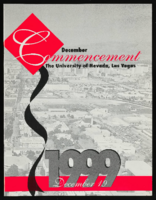
University of Nevada, Las Vegas (UNLV) 36th commencement program
Date
1999-12-19
Archival Collection
Description
Commencement program from University of Nevada, Las Vegas Commencement Programs and Graduation Lists (UA-00115).
Text
Las Vegas Age
Alternate Title
preceded by Las Vegas Times (1905-1906)
Description
The Las Vegas Age was not Las Vegas's first newspaper; that distinction belongs to the short-lived Las Vegas Times which started publishing on March 25, 1905. But only two weeks later, on April 7, C.W. Nicklin founded what was the not-yet-a-city's third paper, the Age. Nicklin edited and published the Age from the Overland Hotel each Saturday as a six-page independent weekly, at $2 per year. When the railroad finally arrived, and laid out and auctioned off the town lots, the Age and its two competitors, the Times and the Advance, boomed with the new town amid lively journalistic debate. The Age briefly triumphed when the Times and Advance collapsed, until new competition arrived, and Nicklin left the Age to his partner Charles C. Corkhill to give his attention to his other paper, the Beatty Bullfrog Miner. Corkhill struggled for two years as editor and publisher, as Las Vegas languished in post-boom depression, then persuaded local businessman Charles P. "Pop" Squires to buy the paper, only after repeatedly dropping the price. Thus began the long and fruitful newspaper career of Charles Squires, sole editor and proprietor of the Age for almost forty years. Even after he sold the paper in 1943, he continued as editor until its last owner, Frank Garside of the Review-Journal, suspended publication of the Age on November 30, 1947.
As the Las Vegas Age, under Squires' shrewd editorship, dominated its local competition as the leading local newspaper with the largest circulation, it also became the leading paper in Southern Nevada. When Las Vegas was founded it was a remote railroad establishment far from the seat of Lincoln County, in Pioche where the county's leading newspaper and the paper of legal record was the Lincoln County Record, which had been in business since 1871. With the rapid growth of Las Vegas and the decline of the Pioche mining district, the population of southern Nevada shifted to the south and the divisions between the southern and northern sections of Lincoln County, which covered the whole of southeastern Nevada, became politically heated. When the Age began publication in Las Vegas in 1905, with a larger circulation than the Record in Pioche, the county commissioners decided to award to the Age all county printing and job work. The editor of the Record, not surprisingly, was enraged and commenced a series of personal attacks on the Age and the residents of Las Vegas, likening the Age to a mushroom fungi of uncertain life, possessing a readership of "floaters, the shiftless and reckless class."
Squires became the city's foremost booster and the Age became his trumpet, fighting for the division of Lincoln County that created Clark County, or for the new dam (an original member of Nevada's Colorado River Commission, Squires was in charge of publicity), or promoting as a one-man Chamber of Commerce civic and community organizations and projects or the city's nascent tourism and resort industry. Thus, the Age became the Voice of Las Vegas, as well as the most respected "paper of record" for the city. Other newspapers came and went, some were political adversaries (Squires was a staunch conservative, pro-business Republican), and some became well-established. But the Age remained the essential Las Vegas newspaper, from its fiercely independent editorials, to its boosterism and its comprehensive reporting of the simple everyday doings of this boisterous and dynamic new city.
See full information about this title online through Nevada's participation in the National Digital Newspaper Project. All issues digitized online at: Chronicling America collection from the Library of Congress.
1913
January
February
March
April
May
June
July
August
September
October
November
1914
January
February
March
April
May
June
July
August
September
October
November
1915
January
February
March
April
May
June
July
August
September
October
November
1916
January
February
March
April
May
June
July
August
Language
English
English
Frequency
Weekly
Place of Publication
Geographic Coverage
International Standard Serial Number (ISSN)
2766-4791
Library of Congress Control Number (lccn)
sn86076141
OCLC Number
13754433
Dealing with Sexual Exploitation Resource Guide, University of Nevada, Las Vegas, July 1992
Date
1998-07
Archival Collection
Description
A UNLV Resource Guide for dealing with sexual exploitation. CSUN Meeting Minutes and Agendas.
Text