
Search Results
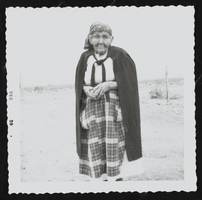
Photograph of Native American elder, Pahrump (Nev.), December 1959
Date
Archival Collection
Description
Image
Transcript of interview with Irwin Molasky by David G. Schwartz, April 23, 2014
Date
Archival Collection
Description
Interview with Irwin Molasky by David G. Schwartz, April 23, 2014. In this interview, Irwin Molasky discusses arriving in Las Vegas in the 1950s, and building the Pyramids motel on the Strip. He talks about the entertainers in various hotels on the Strip, the concept of the "star policy," and bringing Parisian shows to Las Vegas. He goes on to discuss his real estate developments, including Paradise Palms, Boulevard Mall, and Sunrise Hospital, and donating the land for the development of UNLV.
Irwin Molasky came to Las Vegas in 1951, during a time when "everyone knew everyone else," and there was a small, but strong Jewish community. An Army veteran, Irwin and his wife moved to Las Vegas after living in California for a short time. Irwin soon built The Pyramids, a Strip motel next to the Flamingo Hotel and Casino. The Pyramids opened the same day as its northern next-door neighbor, The Sands Hotel and Casino, on December 15, 1952. Irwin used his newly acquired contractor's license to become on the city's most important real estate developers. Over the next 60 years, he built everything from residential housing, including Paradise Palms to commercial properties. Projects included Sunrise Hospital and the surrounding medical buildings; Sunrise City Shopping Center and other power centers; Bank of America Plaza and much other downtown development; and golf courses. When the recession hit, Irwin began bidding on government projects across the country, successfully shielding his business and employees from the economic downturn. Irwin's real estate ventures not only had a tremendous impact on Las Vegas' economic development, but a substantial effect in social programming. Irwin donated 40 acres of prime real estate to the University of Nevada - Las Vegas (UNLV) so that university could expand. Additionally, he was the Founding Chairman of the UNLV Foundation and received an honorary doctorate in humanities.
Text

Transcript of interview with Fred Gibson by Maisie Gibson, March 9, 1975
Date
Archival Collection
Description
On March 9, 1975, Maisie Gibson interviewed Fred Gibson (born 1927 in Golden, Colorado) about his life in Nevada. Gibson first talks about his family’s background, their move to Nevada, and his education in early Las Vegas schools. He also mentions his service in the U.S. Army, his college education, and his occupation as an engineer at various companies. Gibson then talks about the various locations at which he has lived, his membership in clubs and charitable organizations, and his memories of the first properties on Fremont Street as well as those of the Helldorado Parade. The interview then covers the topics of mining, the atomic testing, economic and environmental changes, and social changes. The interview concludes with a discussion on the growth and development of Henderson, Nevada.
Text
Law School Study for the University of Nevada, Las Vegas from Southwestern-Nevada Law Review
Date
Archival Collection
Description
A loose paper version of "Law School Study for the University of Nevada, Las Vegas" by Willard H. Pedrick and Lorne Seidman, photocopied from the Southwestern-Nevada Law Review, Volume 10, 1978. From the University of Nevada, Las Vegas William S. Boyd School of Law Records (UA-00048).
Text


Transcript of interview with Gene Greenberg by Barbara Tabach, February 12, 2015
Date
Archival Collection
Description
In 1976, Gene Greenberg decided to accept a job transfer with Donrey Media Group and relocated from Laredo, Texas to Las Vegas. Las Vegas was comfortable fit and for the next 30 years, he primarily worked in television ad sales. He rose to become executive vice president and general manager of KVBC-TV. Significant to Gene’s ties to Las Vegas have been his ties to the Jewish community. This oral history includes reminiscences of connecting with the Jewish community and meeting many of the Jewish leaders through Young Leadership, Jewish Federation, and being on the board for Temple Beth Sholom. The most poignant aspect to his Jewish roots is the survival of both his parents during Holocaust. Both Helen and Abe Greenberg were from Lodz, Poland and interred in concentration camps. Gene is a frequent presenter of their story for his commitment to Holocaust education and as a member of the next generation. Gene and his wife Melanie both spent their childhoods in Kansas City, Missouri and are graduates of the University of Missouri-Kansas City. They married in 1970 and have three children: Sari Mann, Elissa Burda, and Jaron Greenberg.
Text
Claytee D. White oral history interview
Identifier
Abstract
Oral history interview with Claytee D. White conducted by Stefani Evans on November 2, 2023 for the African Americans in Las Vegas: a Collaborative Oral History Project. In this interview, Claytee D. White, founding directory of the Oral History Research Center at UNLV Libraries, celebrates the twentieth anniversary of the OHRC by contributing her oral history to the collection.
She begins by explaining how the system of sharecropping worked in her family near rural Ahoskie, North Carolina, and she talks about the field work involved in raising cotton, tobacco, corn, and peanuts. The fifth of eight children and the first daughter, she shares memories of going into town with her mother, of admiring her women teachers, and of attending North Carolina Central College (now University) for two years before moving to Washington, D.C., and working for the telephone company.
After recalling her two years in D.C. and 22 years in Los Angeles, California, she describes "running away" to Las Vegas, Nevada in the early 1990s. Here, at the History department at UNLV, she recalls learning to conduct oral histories. White shares memories of her first interviews with Hazel and Jimmy Gay and Lucille Bryant. She talks of matriculating to the College of William and Mary for her PhD and of returning to Bertie County to live with her mother and administer the office of The Shaw University Center for Alternative Programs in Education (CAPE). She describes how she was offered the position of OHRC founding director, why it matters that she was an "opportunity hire," and how it feels to be the only Black person in a room.
Archival Collection