
Search Results

Transcript of interview with Edwina E. Danzienger by Leanne Terry, February 26 & 29, 1980
Date
Archival Collection
Description
On February 26 and 29 of 1980, Leanne Terry interviewed Edwina E. Danzinger (born 1925 in Houston, Texas) about her life in Southern Nevada. Danzinger first talks about her family, specifically her siblings, children, and grandchildren. She also talks about church membership, early housing in Nevada, her husband’s work on the Nevada Test Site, and her family’s hunting practices. Danzinger then describes her involvement in Boy Scouts and hiking, her various positions of employment at the University of Nevada, Las Vegas, how the college campus has changed over time, and how the college students have changed over the years. The two also talk about the changes in the crime rate, the atomic testing, air pollution, and the changes made to the university by the Buckley Amendment.
Text

Transcript of interview with Eldon Cooper by Kamal Whilelm, March 3, 1975
Date
Archival Collection
Description
On March 3, 1975, Kamal Wilhelm interviewed Eldon G. Cooper (born 1922 in Overton, Nevada) about his experiences in Southern Nevada. Also present are Cooper’s wife and several unnamed adults in the background. Cooper first talks about his background and his eventual move to Las Vegas before describing the recreational activities in which he and his family took part. He later describes the atomic testing, environmental changes, modes of transportation, social changes, and tourism in Las Vegas. Cooper also discusses the Stewart Ranch, and his wife describes the setting of multiple photographs taken of properties in the Downtown Las Vegas area.
Text

Transcript of interview with Audrey Wickman by Joanne Goodwin, June 24, 1996
Date
Archival Collection
Description
Born in the coal fields of Strunk, Kentucky, Audrey Aline Messer Wickman first visited the West at twelve years of age. She moved to western Colorado to help in her grandparents’ home for a couple of years. The stay made a lasting impression because she only returned to her birthplace for a short time after that. In Colorado, she graduated from high school, met her future husband, and married in 1925. They came to southern Nevada in 1932 so that Robert Wickman could find work on Hoover Dam. Audrey Wickman joined the Mesquite Club in 1936 and has remained a member to date. She started the Literary Committee as a forum to share book reviews and hear speakers. She served as President of the club for 1947-48 and chose the year’s theme “Know your Neighbor.” In the post-war society, women’s involvement in civic affairs was particularly needed, she told the membership at the opening fall meeting. “The troubles which unsettle the world today are primarily ones which lie within the sphere of women’s business. They are matters of housekeeping, teaching and health. . . . The time has come when we as a nation cannot stay in our own backyards. . . . If we are to be good world citizens, local, state and national, we must first be good home citizens. These responsibilities call for knowledge, an appreciation of other points of view, and attitudes of good will and cooperation.” (Las Vegas Review Journal, 6 October 1947, Mesquite Club microfilm collection.) The duties of the president varied during those years. She recalled that “I was janitor, gardener and President.” During the wintertime, she remembered, “you had to have heat [for Friday’s meeting] and I’d go up on Thursday afternoon and light that old oil burning stove and then pray that it didn’t catch the place on fire all night.” She continued her commitment to club work by serving as state secretary for the Nevada Federation of Women’s Clubs. The friendships and cultural events which came from Mesquite Club and Federation membership proved to be of lasting value for this community builder. This interview has been produced with the assistance of the Mesquite Club and the History Department of the University of Nevada, Las Vegas. It is part of a series on women community builders in Las Vegas. The transcript has been edited only slightly for clarity while the syntax and style of the narrator were retained.
Text
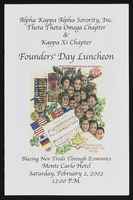
Alpha Kappa Alpha Sorority, Theta Theta Omega Chapter Founders' Day committee reports
Date
Archival Collection
Description
From the Alpha Kappa Alpha Sorority, Incorporated, Theta Theta Omega Chapter Records (MS-01014) -- Chapter records file.
Text
Cherina Kleven oral history interview: transcript
Date
Archival Collection
Description
Oral history interview with Cherina Kleven conducted by Cecilia Winchell on June 9, 2021 for Reflections: The Las Vegas Asian American and Pacific Islander Oral History Project. Cherina Kleven talks about her family and childhood growing up in Taiwan amongst six siblings. She shares her family's history and how they immigrated to Las Vegas while she was a teen, as well as her employment history and how she met her husband. Cherina talks about racial and gender discrimination and the obstacles she has overcome to be the only working female in her family, the only woman firefighter at her station house, and the first female Asian American Assistant Fire Chief in the United States.
Text

Transcript of interview with Elaine Cali McNamara by Claytee White and Stefani Evans, October 5, 2016
Date
Archival Collection
Description
This ability to greet each day with a challenge has laid the foundation for a long history of success for Elaine McNamara as she has navigated through local beauty pageants, an illustrious real estate career, serving on the Las Vegas-Clark County Library board during their decade of expansion to authorship. Her story of resilience starts when she became ill at approximately seven or eight with erythema nodosum that impeded her ability to walk for five months when she started collecting pictures of movie stars. Her favorite movies were any of Roy Rogers, Abbott and Costello, Dean Martin and Jerry Lewis. Her family moved to Las Vegas, where she attended Las Vegas High School as well as UNLV majoring in elementary education and minoring in language arts. While she attended high school, she studied modeling in the evenings to help overcome her shyness and to become more outgoing. Becoming more involved with local and state beauty pageants, she met the likes of Phyllis Diller, Natalie Wood,
Text

Mike Meade interview, February 28, 1977: transcript
Date
Archival Collection
Description
On February 28, 1977, collector Steve Gortz interviewed Mike Meade (b. September 16, 1950 in San Francisco, California) about his life in Nevada. Meade speaks about growing up in Tonopah, Nevada before its decline in population, his move to Elko, Nevada and eventually to the city of Las Vegas. Moreover, he talks about the development of the Strip, the differences between Las Vegas and rural Nevada, as well as the changing environmental landscape. Meade also spends time discussing the controversy surrounding the University of Nevada, Las Vegas (UNLV) dormitory at the time of this interview, the attitude of locals, and his opinion on brothels and prostitution. Lastly, Meade talks about the city’s pollution, the sports and recreation throughout the whole of the state and ends by reading a poem about Nevada from a Bicentennial book.
Text

Barbara Millington interview, March 2, 1980: transcript
Date
Archival Collection
Description
On March 2, 1980, collector David Mowrey interviewed Barbara Millington (born July 3rd, 1937 in Oak Creek, Colorado) at her home in Las Vegas, Nevada. In this interview, Mrs. Millington discusses moving to Las Vegas, Nevada with her family and working various jobs including at Vegas Village and becoming a bookkeeper at a construction firm. She also speaks about the changes she has seen in Las Vegas, such as how casinos were when she first came here compared to how they are now. She ends the interview talking about the need for Las Vegas to find industry outside of gaming. She discusses the need for young people to come back after going away to college to improve the city.
Text

Mario Sandoval interview, December 6, 2018: transcript
Date
Archival Collection
Description
Interviewed by Claytee White. Mario and his six siblings were reared by a single mother who taught him all of the family recipes. Moving to Las Vegas at four years of age Mario remembers moving into a black neighborhood where the family was not welcomed. All windows in their home were broken into the first night. The family moved the next day. Though the new house was still in an African American neighborhood, they were protected by Vera, their black babysitter. Mario developed the intense work ethic of his mother, and after working in several strip casinos, found his home at the Horseshoe, today's Binion's. He has been there for 33 years; first as a busboy and then becoming a waiter. He is a Culinary Union trained shop student who picketed his beloved work place for ten months during a 1980's labor dispute. His work in life and union benefits have made his a very good life.
Text