Search Results

Interview with Roger Ray, October 29, 2005
Date
Archival Collection
Description
Text

Transcript of interview with Billy Paul Smith by Claytee White, October 3, 2013
Date
Archival Collection
Description
Chemist, mathematician, and health physicist Billy Paul Smith donates time to tutor young people in hopes of attracting more youth into the fields of math and science. Born in 1942 and schooled in segregated black schools in Shreveport, Louisiana, and Texarkana, Texas, he graduated from high school at age fifteen and enrolled at Prairie View A&M University, where he trained with the Reserve Officer Training Corps (ROTC) and earned his Bachelor’s degree in chemistry and in 1964 his Master’s degrees in chemistry and math. Most young U.S. Army officers in 1964 went to Vietnam, but Billy’s math and science background steered him to the Army Chemical Corps, where he was quickly selected to join a new team. The team was to develop responses to nuclear weapon accidents and worked under the Defense Atomic Support Agency (DASA) in Albuquerque, New Mexico. At the same time, Billy completed the Weapons Ordinance Army course on classified information relating to the U.S. nuclear weapons arsenal. In this interview, Billy talks about his service with DASA and his subsequent twenty-seven years working at the Nevada Test Site in a variety of positions with Reynolds Electrical and Engineering Company, Inc. (REECo), a company that had “percentagewise more blacks in management positions than any other [Las Vegas] company.” He experienced the quiet racism of Las Vegas residential segregation when he tried to purchase a house in a neighborhood he liked and the unexpected kindness of the REECo general manager, Ron Keen, who made sure the Smith family could live where they wanted to live. He talks about Area 51 and explains underground testing activity and offers the scientific and ecological reasons why scientists deemed Yucca Mountain safe to store nuclear waste. After retiring at fifty-two, Billy and a colleague formed an independent instrumentation company, which, from 1995–2005 provided and calibrated radiological measurement and detection instruments for the decommissioning and closure of the Rocky Flats nuclear plant in Golden, Colorado. During that time, Billy rented an apartment in Boulder, but he and Jackie maintained their Las Vegas home, where they still reside. Billy shares memories of places he and his wife used to enjoy on the Westside and tells of their longtime friends in the black community. He also talks about developing his philosophy of philanthropy through Alpha Phi Alpha Fraternity and discusses becoming a member of the Knowledge Fund Advisory Council for the Governor’s Office of Economic Development (GOED) and the advisory council for the Nevada System of Higher Education.
Text

Transcript of interview with Cathie Millson by Anna Huddleston, June 10, 2014
Date
Archival Collection
Description
Cathie and Chris Millson moved to Las Vegas with their one-year-old daughter, Nicole, in 1984 following Chris’s completion of a cardio-thoracic anesthesiology fellowship in Atlanta, Georgia. Their two other children were born in Las Vegas. Shortly after they arrived they purchased the Rancho Bel Air house where they currently reside. Cathie talks about raising her children and living in Rancho Bel Air, a gated neighborhood of custom houses, which grew to maturity after the Millsons moved in. Cathie’s memories chronicle the growth of Las Vegas from small town to large city, how a certain segment of the population lived and entertained, and how downtown revitalization has brought young people back to Rancho Bel Air to raise their families.
Text
University of Nevada, Las Vegas law school planning: reports, correspondence, and clippings
Date
Archival Collection
Description
Folder contains materials related to establishing a law school at UNLV, including: "pre-law at UNLV" brochure, August 1975; lists of related archival materials; "UNLV Law" survey of previous law school studies, compiled by Jan Gould, 1976; an issue of "Factor E" magazine containing "The Law School Story," spring 1975; newspaper clippings; and other related reports and correspondence. From the University of Nevada, Las Vegas William S. Boyd School of Law Records (UA-00048).
Text
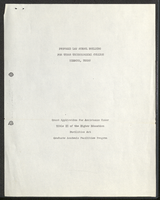
Law schools and law libraries: grant application, bibliography, article, and memos
Date
Archival Collection
Description
Folder contains a grant application for a proposed law school building for Texas Technological College, 1966; a bibliography of resources related to law schools; a scholarly article titled "Libraries, Liberties, and the First Amendment" by Robert M. O'Neil, 1973; and memos related to the development of a law library at UNLV. From the University of Nevada, Las Vegas William S. Boyd School of Law Records (UA-00048).
Text
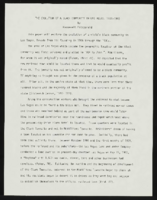
"The Evolution of a Black Community in Las Vegas: 1905-1940": manuscript draft by Roosevelt Fitzgerald
Date
Archival Collection
Description
From the Roosevelt Fitzgerald Professional Papers (MS-01082) -- Unpublished manuscripts file.
Text

Transcript of interview with Elaine Cali McNamara by Claytee White and Stefani Evans, October 5, 2016
Date
Archival Collection
Description
This ability to greet each day with a challenge has laid the foundation for a long history of success for Elaine McNamara as she has navigated through local beauty pageants, an illustrious real estate career, serving on the Las Vegas-Clark County Library board during their decade of expansion to authorship. Her story of resilience starts when she became ill at approximately seven or eight with erythema nodosum that impeded her ability to walk for five months when she started collecting pictures of movie stars. Her favorite movies were any of Roy Rogers, Abbott and Costello, Dean Martin and Jerry Lewis. Her family moved to Las Vegas, where she attended Las Vegas High School as well as UNLV majoring in elementary education and minoring in language arts. While she attended high school, she studied modeling in the evenings to help overcome her shyness and to become more outgoing. Becoming more involved with local and state beauty pageants, she met the likes of Phyllis Diller, Natalie Wood,
Text

Transcript of interview with Jarmilla McMillan-Arnold by Claytee D. White, October 7, 2010
Date
Archival Collection
Description
Jarmilla McMillan-Arnold’s father, Dr. James B. McMillan, was the first black dentist in the state of Nevada. Dr. McMillan’s colleagues consisted of Dr. West, the first black medical doctor in the state, and Dr. Ice, the first black surgeon in Nevada. This interview highlights and archives the solid foundation upon which Nevada’s black community was built. Jarmilla recalls early memories of growing up as the daughter of Las Vegas NAACP president Dr. McMillan. She was born in Detroit, Michigan, to a Caucasian and Indian mother who was a professional dancer. Jarmilla’s parents separated when she was very young and as a result she was raised by her paternal grandmother who owned a restaurant in Pontiac, Michigan. Jarmilla describes her grandmother as being well-known and highly regarded in the community where she maintained her business. Jarmilla attended Catholic schools in Detroit, Pontiac, and Las Vegas. Having moved to Las Vegas with her father, Jarmilla’s narrative offers keen insigh
Text

Sylvia Alvarado interview, April 12, 2019: transcript
Date
Archival Collection
Description
Interviewed by Rodrigo Vazquez, Monserrath Hernández, and Barbara Tabach. Sylvia Alvarado talks about growing up in North Las Vegas and her Catholic upbringing in a Mexican household. Her studies in Journalism & Media Studies led her to her career as a radio host on English and Spanish-speaking programs. She also talks about speaking "pocha" Spanish and the Latinx influence in radio programming.
Text
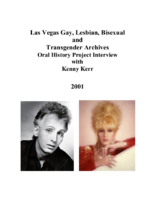
Transcript of interview with Kenny Kerr by Dennis McBride, May 29 & 30, 2001
Date
Archival Collection
Description
In the years following this interview, Kerr continued entertaining, although he never returned to the Las Vegas Strip. Kerr performed at OUTfest Phoenix, at Palm Springs’ Awesome August celebrations, Las Vegas’ National Coming Out Day event, and for the Gay and Lesbian Community Center’s Youth Service’s Division. Kerr also gave shows at small bars and restaurants such as Café Nicolle and DeStefano’s in Las Vegas, the Wilde Goose in Cathedral City, California, and the Plush Room in San Francisco. There were rumors that Kerr was set to replace emcee Joey Arias in Cirque du Soliel [2004] and Frank Marino in La Cage [2005], but neither turned out to be true. Instead, Kerr performed in such local gay nightclubs as Flex, Sasha’s, Krave, Suede, and, on July 31, 2012, at the Onyx Theatre in Commercial Center. In 2006, Kerr made peace with his former rival, Frank Marino. Kerr’s son, Kristin Vidal, made Kenny a grandfather with his own son, Alexander. It was clear during his July 2012 performan
Text