Search Results

Catherine Abrigo oral history interview: transcript
Date
Archival Collection
Description
Oral history interview with Cathrine Abrigo conducted by Cecilia Winchell and Stefani Evans on July 20, 2022 for the Reflections: the Las Vegas Asian American and Pacific Islander Oral History Project. In this interview, Abrigo describes her early life in the Philippines, where she attended Catholic school and briefly studied medical technology in college. She describes immigrating to Las Vegas, Nevada with her husband and the difficulty of leaving her immediate family behind. She discusses working for the Cosmopolitan in 2011 and becoming deeply involved with the Culinary Workers Union Local 226. Throughout the interview, Abrigo talks about religion, food, and her activism with the Culinary Union.
Text
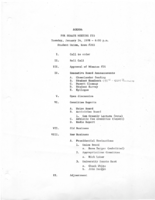
Meeting minutes for Consolidated Student Senate, University of Nevada, Las Vegas, January 24, 1978
Date
Archival Collection
Description
Text

Interview with Sidney D. Drell, July 20, 2004
Date
Archival Collection
Description
Text

Interview with Harold David Cunningham, March 11, 2004
Date
Archival Collection
Description
Text

Interview with Stephen Craig Ronshaugen, November 26, 2004
Date
Archival Collection
Description
Text

Magdalena Martinez oral history interview: transcript
Date
Archival Collection
Description
Oral history interview with Magdalena Martinez conducted by Monserrath Hernandez and Barbara Tabach on April 4, 2019 for the Latinx Voices of Southern Nevada Oral History Project. In this interview, Magdalena Martinez recalls her childhood and growing up in Los Angeles, California. Martinez's parents are from Durango, Mexico, and immigrated to the United States in the 1970s. Martinez describes the generational differences that the women in her family faced and how the feminist movement of the 1970s did not resonate with women of color. Her family moved to Las Vegas in 1986 where she attended Bishop Gorman High School. After transferring to the University of Nevada, Las Vegas (UNLV) from community college and joining a student organization that would later become Student Organization of Latinxs, she became an early member of the Latino Youth Leadership Conference (LYLC) sponsored by the Latin Chamber of Commerce. Martinez describes how the LYLC has evolved over the years, and talks about her role in those changes. She discusses past work for CSN, NSHE, and currently is the Director of Education Programs with the Lincy Institute.
Text

Transcript of interview with Thomas Rodriguez by Maribel Estrada Calderón, September 10, 2018
Date
Archival Collection
Description
Known for “raising hell and making a difference” in the Las Vegas Valley, Thomas Rodriguez has dedicated more than four decades of his life to the political, educational, and social advancement of the Latinx community. Tom was born in 1940 to Jennie Gomez and Joseph Rodriguez in a Topeka, Kansas neighborhood its residents called The Bottoms. Mexicans, Mexican Americans, American Indians, African Americans, among other peoples lived in this diverse and beloved community. In 1956, the Urban Renewal Program, a program funded by the Federal Government that sought to raze neighborhoods the city considered to be “slums,” forced The Bottoms’ residents to abandon their homes. Rodriguez recalled the effects that this event had on his family and on his educational career. Despite his family’s relocation, he graduated from a high school located in a nearby neighborhood in 1958. Years later, the activism and ideology of the Chicano Movement of the 1960s taught Rodriguez that to overcome the injus
Text

Patricia Vazquez interview, November 14, 2018, June 14, 2019: transcript
Date
Archival Collection
Description
Session 1: Interviewed by Marcela Rodriguez-Campo. Barbara Tabach also participates in the questioning. Session 2: Interviewed by Rodrigo Vazquez. Monserrath Hernandez also participates in the questioning. Patricia Vazquez was born and raised in Las Vegas, NV and shares her experiences growing up in the Valley as a Queer Latina. At a young age, she remembers traveling back and forth between Mexico and the U.S. to visit family. When she started school she shares how her home language, Spanish, became her family's "secret language" as she began to learn English. During elementary school Patricia was tracked into the special education program, and remove from the mainstream classroom. She would find her love for learning in books and libraries as she taught herself how to read in English. Despite being tracked into less advanced courses, Patricia would end up taking AP/ Honors courses in high school after forging her favorite teachers signature, which changed her educational trajectory. After coming out to her family, Patricia went nearly a decade distanced from her mother and continued her college education at Arizona State University. There, she would complete a bachelors in painting and a masters in comparative literature. Her work with the Chicano Studies program at ASU helped her develop her Chicana identity and begin her involvement in social activism. In Las Vegas, she worked to fight for marriage equality and LGBTQ rights with the American Civil Liberties Union , and later with the Progressive Leadership Alliance of Nevada. She also conducted several lectures for the Latino Youth Leadership Conference on sexuality, gender, and homophobia for over a decade. She has served as an English Professor at the College of Southern Nevada for the last 20 years and is an avid hiker, traveler, and painter.
Text