
Search Results

Video, Holocaust Survivors Group of Southern Nevada Hanukkah Celebration at the Venetian Hotel, December 9, 2012
Date
Archival Collection
Description
The video documents the Hannukah gathering at the Venetian organized by the Holocaust Survivors Group of Southern Nevada. The program includes speeches and entertainment.
Moving Image

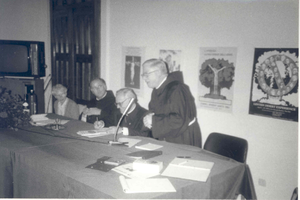
Sister Rosemary Lynch sitting on a panel in an anti-nuclear meeting: photographic print
Date
Archival Collection
Description
Image
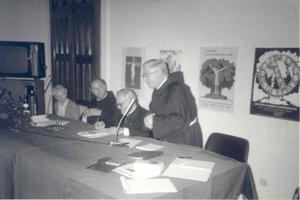
Sister Rosemary Lynch with others in an anti-nuclear meeting: photographic print
Date
Archival Collection
Description
Image
American Legion Auxiliary, image 003
Date
Description
Image
American Legion Auxiliary, image 004
Date
Description
Image
American Legion Auxiliary, image 005
Date
Description
Image

Transcript of interview with Elizabeth "Betty" Krolak by Irene Rostine, September 26, 1995
Date
Archival Collection
Description
In 1962, Elizabeth “Betty” Krolak moved from the Midwest to Las Vegas with her husband and six children. Not only would the drier desert climate benefit her youngest daughter’s health due to asthma, but the family hoped the Las Vegas economy would be beneficial for their future. Prior to her arrival in Las Vegas, Betty worked briefly as a secretary for the New York Central Railroad before becoming a stay-at-home mom and active member of the PTA. Upon their arrival in Las Vegas, Betty’s husband enrolled in a real estate class, but was unable to complete the program. Betty, not wanting to waste the $80 they had spent on the class, decided to attend in his place. This decision led to life changing events for Betty and her family over the next four decades. After taking the real estate class and passing the test, Betty became a licensed Nevada real estate broker in October of 1963. She initially went to work for Pyramid Realty and, in 1964, she opened her own office, Clark County Realty. After her divorce in 1967, Betty was left with “six hungry children” to feed and no child support or health insurance. She recalls how the benefits of being in real estate really became apparent during this period of her life. While real estate required long hours seven days a week, it also afforded a single mother flexibility that other careers would not have offered. Likewise, a woman could make more money in real estate in the 1960s and 1970s than most other careers provided, which was particularly important for Betty who was committed to raising her children without public assistance. Betty’s oral history chronicles the growth of the Las Vegas Board of Realtors which has grown into what today is the Greater Las Vegas Association of Realtors (GLVAR). She recalls how, in the 1960s, meetings took place in bowling allies and the primary role of the GLVAR was to provide networking opportunities and represent the Code of Ethics for realtors. However, the Board was dominated by males, with the role of women members confined to planning social events and arranging for refreshments. In 1968, Betty and several other women realtors set out to change this by initially establishing a local Women’s Council within the Board. In the years following, Betty became the first women to be an Executive Board Member. Today, more than half the members of the Executive Board are women. Betty’s oral history also speaks to many changes within the real estate industry over the past four decades, some positive and some not so positive. She recounts the 1960s to the 1980s, when casino workers’ main source of income came from tips which were often unreported, creating challenges in getting casino workers qualified for home loans because they did not have the ability to document their source of income. Likewise, single women had a hard time qualifying for home loans because they only had one income and, in those days, it rarely was enough to qualify for a mortgage on their own. Also during this period, realtors primarily focused on the resale market because builders wanted to work directly with buyers, but changes in the real estate market eventually led builders to realize the benefits of allowing realtors to sell new houses, too. During her career, Betty also experienced the rise of real estate franchises, beginning with Century 21’s arrival in Nevada, the development of Multiple Listing Service (MLS), changes to educational requirements, approaches to settling disputes, and new approaches to ethics violations. Perhaps the biggest change Betty’s oral history speaks to is the personal approach to selling real estate that has been lost over time. In the early days, brokers sold houses right alongside the sales agents. Today, however, regulations have placed brokers in a position where their primary role is to manage sales people, not sell houses. Also, realtors used to interact with other realtors, title company personnel, and mortgage lenders before technology, such as fax machines and computers, came along. In the early days, documents were transferred in person allowing people in the industry to get to know one another through these personal interactions. Today, everything is done electronically and it is rare to actually know the person on the other end. Selling real estate has lost a lot of its personal touch, according to Betty. In addition to being the mother of six children and running one of the largest real estate offices in the area, Betty also found time to give back to the community through her volunteer work with the Salvation Army. She was instrumental in establishing Southern Nevada’s Angel Tree project, which provides Christmas presents to children who otherwise would not receive them. She was also appointed by Governor Michael O’Callahan to the State of Nevada’s Real Estate Commission, making her the first woman to serve on the Commission. Betty’s career in real estate allowed her to witness and implement many changes that still impact the industry today. When Betty began her career, Las Vegas’ population was just over 45 thousand. By the mid-1990s Green Valley, Spring Valley, North Las Vegas, Summerlin, and Sun City had been developed and the Valley’s population exceeded 1 million people. Betty Krolak’s career merged with the real estate boom as she helped find homes for those who wanted to make Las Vegas their home. She made sure the real estate industry’s growth included women, training mechanisms, and ethics which continue to benefit realtors, home buyers, and home sellers to this day.
Text