
Search Results
Insignia Films Research for the American Experience: Las Vegas - An Unconventional History
Identifier
MS-00508
Abstract
The Insignia Films Research for the "American Experience: Las Vegas - An Unconventional History" collection (1968, 2004-2005) contains photocopied research material, primarily drawn from Nevada newspapers, photographic prints, Betacam and VHS videotapes with interviews and footage used in the Public Broadcasting System (PBS) series "American Experience: Las Vegas - An Unconventional History," created for the Las Vegas Centennial, Las Vegas, Nevada. Also included are original issues of Look magazine with Las Vegas, Nevada coverage, and a United States Freedom of Information Act (USFOIA) report on Tony Spilotro.
Archival Collection
Dorothy Keeler Papers
Identifier
MS-00195
Abstract
The Dorothy Keeler Papers (1811-1977) document early Las Vegas history, the life and career of former United States Mint director Eva Adams, and contain images of the Western United States and Southern Nevada in the 1930s. The collection contains clippings on the history of Las Vegas and early Las Vegas weddings as well as photographs documenting the Keelers' travels throughout the Western United States and the construction and dedication of Hoover Dam.
Archival Collection
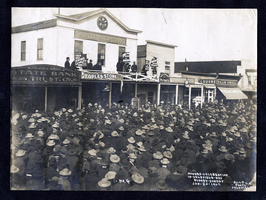
Photograph of a crowd attending a Miners Union event on 2nd Anniversary of Bloody Sunday Massacre in Russia, Goldfield (Nev.), January 20, 1907
Date
1907-01-20
Archival Collection
Description
[Industrial Workers of the World]
Caption: Miners-celebration in-Goldfield-Nev Bloody-Sunday Jan-20-1907
Site Name: Miners Union Hall (Goldfield, Nev.)
State Bank and Trust Company (Goldfield, Nev.)
Palm Grill (Goldfield, Nev.)
Caption: Miners-celebration in-Goldfield-Nev Bloody-Sunday Jan-20-1907
Site Name: Miners Union Hall (Goldfield, Nev.)
State Bank and Trust Company (Goldfield, Nev.)
Palm Grill (Goldfield, Nev.)
Image
Bob Friedlander Jazz Music Manuscripts
Identifier
MS-00979
Abstract
The Bob Friedlander Jazz Music Manuscripts (approximately 1960-1980) are comprised of music manuscripts arranged by Bob Friedlander and collected by the Arnold Shaw Popular Music Research Center at the University of Nevada, Las Vegas (UNLV) in Las Vegas, Nevada. Some titles are photocopies of the original manuscript. Friedlander arranged for big band musicians such as Harry James, Sam Donahue, Richard Maltby, Ralph Flanagan, and Johnny Long.
Archival Collection
Prima, Louis, 1910-1978
Louis Prima (1910-1978) was an American singer, songwriter, trumpeter, bandleader, and actor during the mid-20th century. He was known for performing jazz, swing, and jump blues music. Using his background from New Orleans and his Italian heritage to shape his distinctive sound, he encouraged other performers at the time to embrace their ethnic heritage. He frequently performed with his wife, Keely Smith, at the height of his popularity.
Person
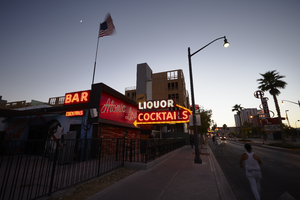
Photographs of Atomic Liquors at dusk, Las Vegas (Nev.), June 28, 2017
Date
2017-06-28
2017-08-12
Archival Collection
Description
The Atomic Liquors bar sits at 927 Fremont Street in Downtown Las Vegas. Information about the sign is available in the Southern Nevada Neon Survey Sheet.
Site address: 927 Fremont St
Sign owner: 100 10th Street LLC
Sign details: Property sold by Lance Johns to 100 10th Street LLC in 2014 for $3,480,000. Recent addition to property in 2017 (927 Fremont Street).
Sign condition: 3 - Decent: neon in great condition, paint chipping off and some bulbs not repaired
Sign form: Directional Monument sign, back to back "Double sided"
Sign-specific description: Uses directional tool of an arrow, has chasing animation in the arrow with incandescent bulbs. It has blade like additions to it for the word "Liquor" and "Cocktails", each word on its own blade which are parallel to the ground, they are painted red. The word "Atomic" sits on the top in a comic style "blast" shaped bubble painted yellow. "Packaged liquors" and "Cold beer" painted on the base structure of the sign. Bulbs glow yellow, "Liquor" glows blue, "Cocktails" glows red, "Atomic" is not lit.
Sign - type of display: Neon and incandescent
Sign - media: Steel
Sign animation: Chaser effect with bulbs
Sign environment: Property surrounded by other bars/clubs and motels.
Sign - date of installation: c. 1952
Sign - artistic significance: 1950s atomic testing theme - popular due to test sight 65 miles north of city
Survey - research locations: Bar website, www.roadarch.com, owner
Surveyor: Danny Jacobs
Survey - date completed: 2017-08-12
Sign keywords: Neon; Incandescent; Steel; Chasing; Directional; Monument sign; Back to back; Fascia; Floating Mount Letters
Site address: 927 Fremont St
Sign owner: 100 10th Street LLC
Sign details: Property sold by Lance Johns to 100 10th Street LLC in 2014 for $3,480,000. Recent addition to property in 2017 (927 Fremont Street).
Sign condition: 3 - Decent: neon in great condition, paint chipping off and some bulbs not repaired
Sign form: Directional Monument sign, back to back "Double sided"
Sign-specific description: Uses directional tool of an arrow, has chasing animation in the arrow with incandescent bulbs. It has blade like additions to it for the word "Liquor" and "Cocktails", each word on its own blade which are parallel to the ground, they are painted red. The word "Atomic" sits on the top in a comic style "blast" shaped bubble painted yellow. "Packaged liquors" and "Cold beer" painted on the base structure of the sign. Bulbs glow yellow, "Liquor" glows blue, "Cocktails" glows red, "Atomic" is not lit.
Sign - type of display: Neon and incandescent
Sign - media: Steel
Sign animation: Chaser effect with bulbs
Sign environment: Property surrounded by other bars/clubs and motels.
Sign - date of installation: c. 1952
Sign - artistic significance: 1950s atomic testing theme - popular due to test sight 65 miles north of city
Survey - research locations: Bar website, www.roadarch.com, owner
Surveyor: Danny Jacobs
Survey - date completed: 2017-08-12
Sign keywords: Neon; Incandescent; Steel; Chasing; Directional; Monument sign; Back to back; Fascia; Floating Mount Letters
Mixed Content
C. A. Earle Rinker Photograph Collection of Goldfield, Nevada
Identifier
PH-00350
Abstract
The C. A. Earle Rinker Photograph Collection of Goldfield, Nevada (approximately 1900-1915) contains individual black-and-white photographic prints, photographic albums, black-and-white and tinted postcards, and photographic negatives that document the history of early twentieth century Goldfield, Nevada. The images include photographic prints of Goldfield and surrounding areas during its peak years of 1906-1910; postcards showing scenes of Goldfield, Tonopah, and other areas in central Nevada; and negatives that contain images of Rinker's family and homelife in Indiana and Illinois.
Archival Collection
Transcript of interview with Ron Lawrence by Dennis McBride, June, July and August 1997
Date
1997-07-22
1997-07-11
1997-08-08
1997-08-22
Archival Collection
Description
Ron Lawrence is one of the busiest people in the gay community, so I want him to know how much I appreciate his reserving time for me so that I could complete this oral history interview. The importance of his work toward the well-being of the gay community in Las Vegas cannot be measured, and much of what he's accomplished and otherwise made possible will live long after he leaves us. With Ron's consent to this interview, our knowledge of Nevada's gay history is greatly enriched and our record preserved.
Text

Transcript of interview with David Wasserman by Barbara Tabach, October 21, 2016
Date
2016-10-21
Archival Collection
Description
For nearly two decades between 1950 and 1970, only one dentist of Jewish ancestry was known to be licensed to practice in Nevada. That was Dr. Joe Chenin. Finally, in 1971, the steadfast and easy mannered Dr. David R. Wasserman (1944 - ) broke through the barrier to become the second Jewish dentist serving the Las Vegas community. Over the following years, Dr. Wasserman built a sizeable following and immersed himself in the Jewish community of Las Vegas. Among his achievements is his participation and leadership in the formation of Las Vegas’ first Reform Jewish synagogue, Congregation Ner Tamid. He also would be active in the Jewish Federation. In 1992, as the HIV-AIDS epidemic affected dental offices throughout the nation, Dr. Wasserman saw an opportunity to get ahead of the infection. With the help of his wife Juanita Davis-Wasserman and his father-in-law Warren Davis, he developed, patented, manufactured and distributed a disposable tip for a treatment instrument commonly found in dental offices called a tri-syringe. This disposable tip brought sanitary options and great financial fortune to Dr. Wasserman and his family. In this oral history, Dr. Wasserman reflects on his joy of living in Las Vegas. He is a highly regarded dentist and leader in the Jewish community.
Text