
Copyright & Fair-use Agreement
UNLV Special Collections provides copies of materials to facilitate private study, scholarship, or research. Material not in the public domain may be used according to fair use of copyrighted materials as defined by copyright law. Please cite us.
Please note that UNLV may not own the copyright to these materials and cannot provide permission to publish or distribute materials when UNLV is not the copyright holder. The user is solely responsible for determining the copyright status of materials and obtaining permission to use material from the copyright holder and for determining whether any permissions relating to any other rights are necessary for the intended use, and for obtaining all required permissions beyond that allowed by fair use.
Read more about our reproduction and use policy.
I agree.Information
Details
More Info
Transcription
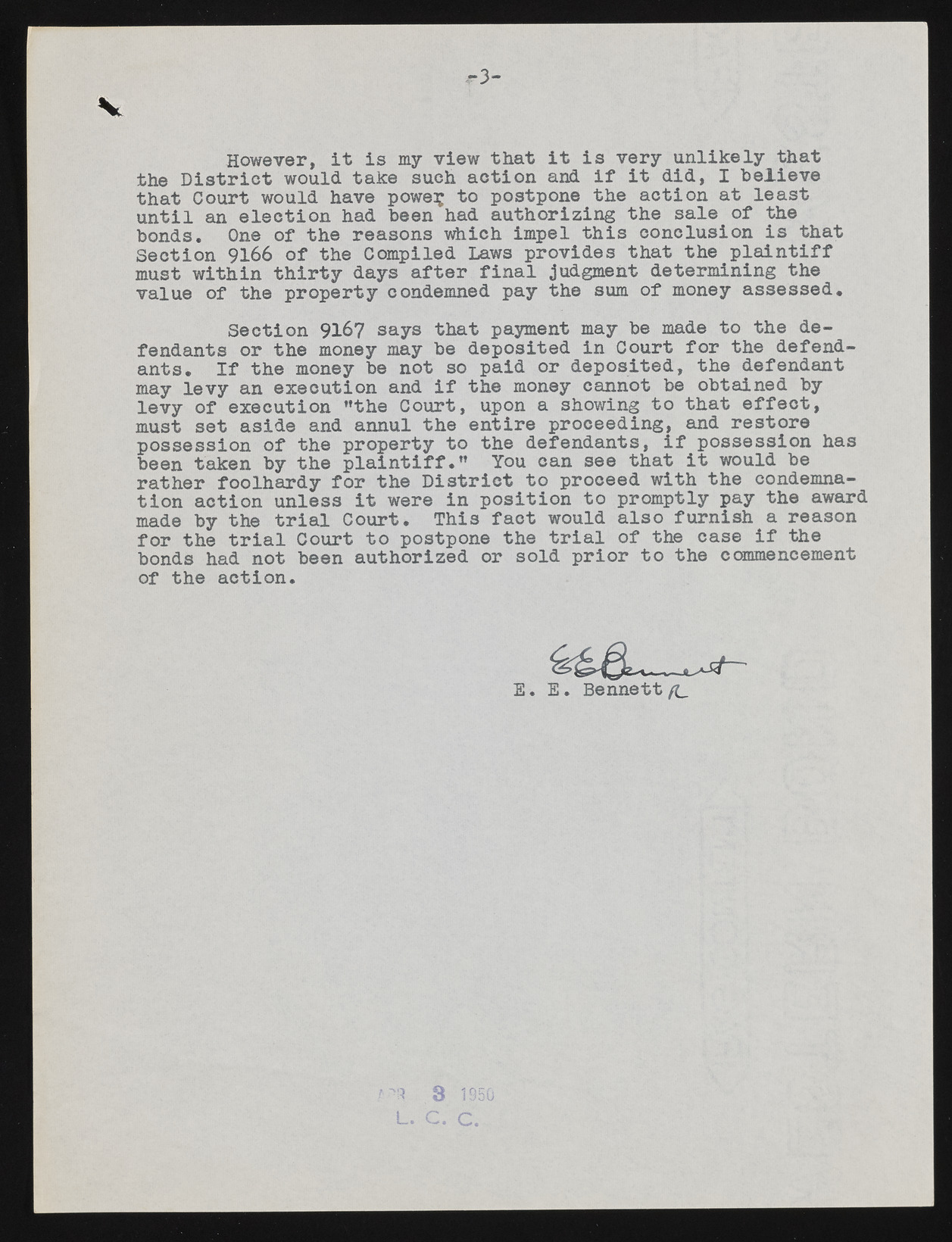
V C 3- However, i t is my view that i t is very unlikely that the D istrict would take such action and i f i t did, I believe that Court would have powe^ to postpone the action at least u n til an e lection had been had authorizing the sale of the bonds. One of the reasons which impel th is conclusion is that Section 9166 o f the Compiled Laws provides that the p la in t iff must within th irty days a fter fin a l judgment determining the value of the property condemned pay the sum of money assessed. Section 9167 says that payment may be made to the defendants or the money may be deposited in Court fo r the defendants. I f the money be not so paid or deposited, the defendant may levy an execution and i f the money cannot be obtained by levy of execution ’’the Court, upon a showing to that e ffe c t , must set aside and annul the entire proceeding, and restore possession o f the property to the defendants, i f possession has been taken by the p l a i n t i f f .” You can see that i t would be rather foolhardy fo r the D istrict to proceed with the condemnation action unless i t were in position to promptly pay the award made by the t r ia l Court. This fa ct would also furnish a reason fo r the t r ia l Court to postpone the t r ia l o f the case i f the bonds had not been authorized or sold prior to the commencement of the action . E. E. Bennett/t. 1? 3 1 Q L. C. c .