UNLV Special Collections provides copies of materials to facilitate private study, scholarship, or research. Material not in the public domain may be used according to fair use of copyrighted materials as defined by copyright law. Please cite us.
Please note that UNLV may not own the copyright to these materials and cannot provide permission to publish or distribute materials when UNLV is not the copyright holder. The user is solely responsible for determining the copyright status of materials and obtaining permission to use material from the copyright holder and for determining whether any permissions relating to any other rights are necessary for the intended use, and for obtaining all required permissions beyond that allowed by fair use.
This material is made available to facilitate private study, scholarship, or research. It may be protected by copyright, trademark, privacy, publicity rights, or other interests not owned by UNLV. Users are responsible for determining whether permissions are necessary from rights owners for any intended use and for obtaining all required permissions. Acknowledgement of the UNLV University Libraries is requested. For more information, please see the UNLV Special Collections policies on reproduction and use (https://www.library.unlv.edu/speccol/research_and_services/reproductions) or contact us at [email protected].
Digital Provenance
Digitized materials: physical originals can be viewed in Special Collections and Archives reading room
Publisher
University of Nevada, Las Vegas. Libraries
Transcription
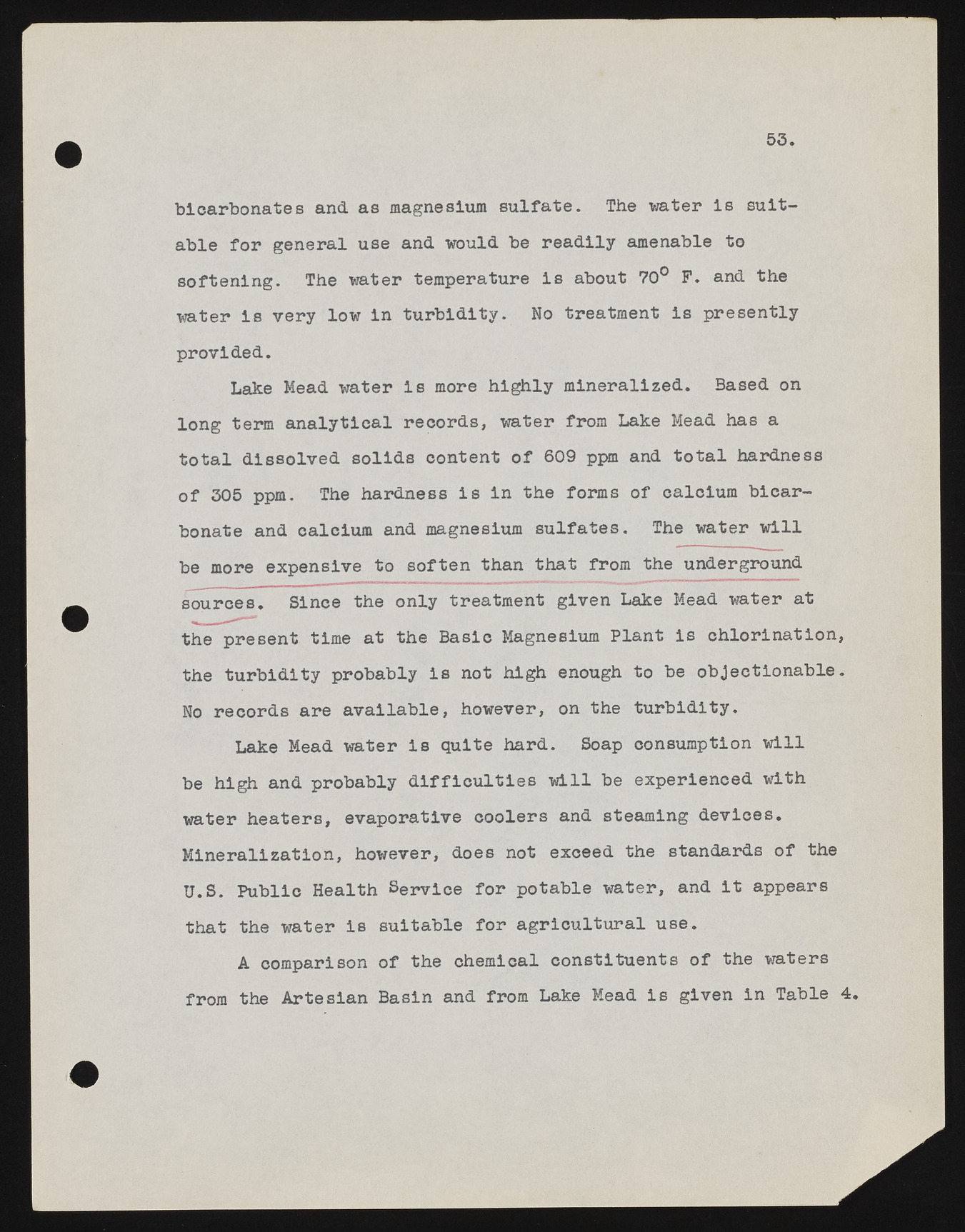
53. bicarbonates and as magnesium sulfate. The water Is suitable for general use and would be readily amenable to softening. The water temperature is about 70° P. and the water is very low in turbidity. No treatment is presently provided. Lake Mead water is more highly mineralized. Based on long term analytical records, water from Lake Mead has a total dissolved solids content of 609 ppm and total hardness of 305 ppm. The hardness is in the forms of calcium bicarbonate and calcium and magnesium sulfates. The water will be more expensive to soften than that from the underground sources. Since the only treatment given Lake Mead water at the present time at the Basic Magnesium Plant is chlorination, the turbidity probably is not high enough to be objectionable. No records are available, however, on the turbidity. Lake Mead water is quite hard. Soap consumption will be high and probably difficulties will be experienced with water heaters, evaporative coolers and steaming devices. Mineralization, however, does not exceed the standards of the U.S. Public Health Service for potable water, and it appears that the water is suitable for agricultural use. A comparison of the chemical constituents of the waters from the Artesian Basin and from Lake Mead is given in Table 4.